From Nokia to Blockbuster: How Marketing Myopia Causes Market Leaders to Fail
Discover how marketing myopia led giants like Nokia and Blockbuster to overlook changing customer needs, emerging technologies, and shifting markets. This case study explores the strategic mistakes that caused once-dominant companies to lose their competitive edge.
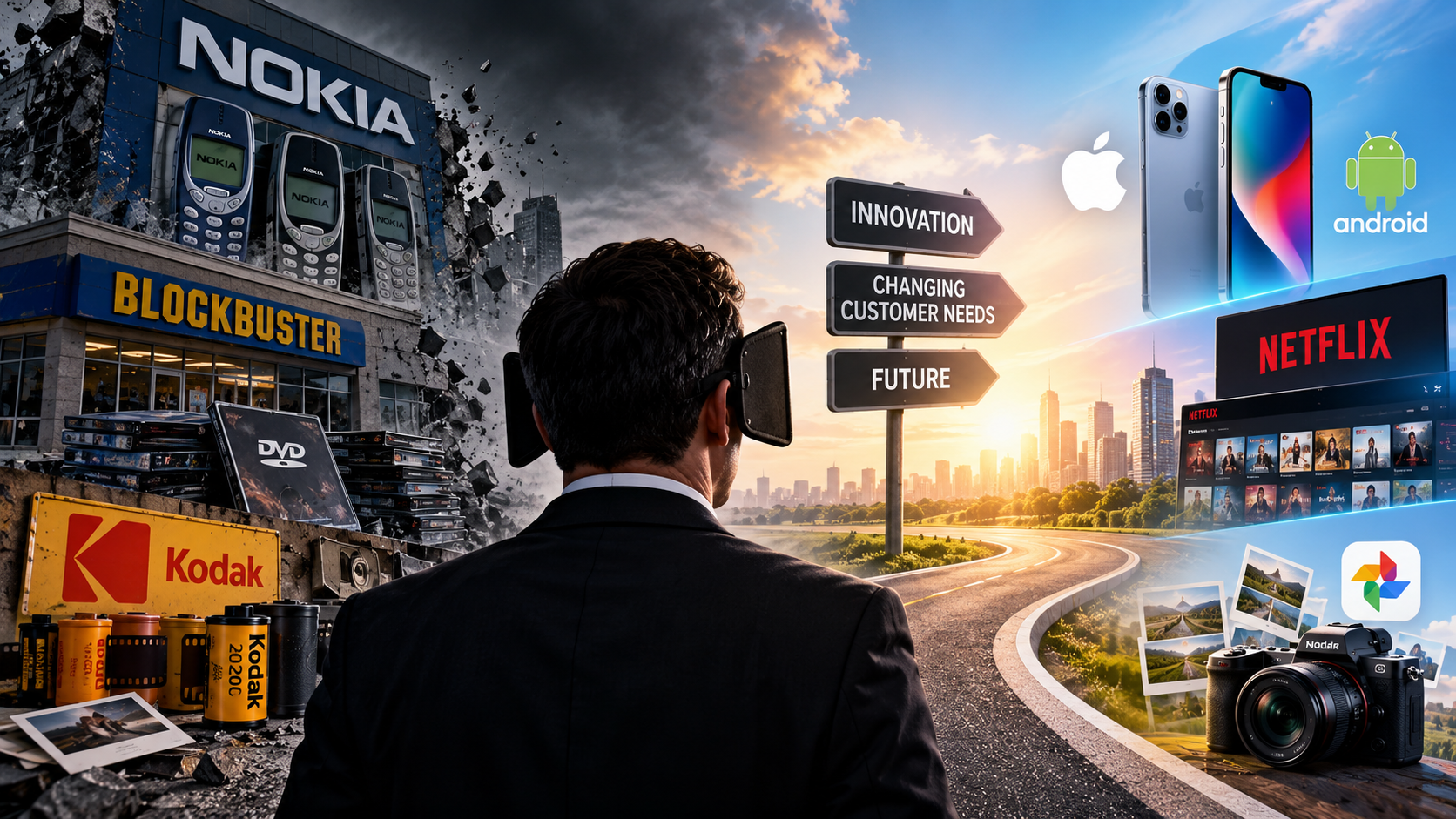
Introduction: When Success Becomes a Blind Spot
Market leadership can create a dangerous illusion: that what made a company successful today will continue to make it successful tomorrow. Businesses that dominate their industries often become highly efficient at producing, selling, and improving the products that already generate revenue. The problem begins when customers, technology, or the market itself changes and the company continues looking at the future through the lens of its existing business.
This is the central idea behind marketing myopia, a concept introduced by marketing scholar Theodore Levitt. Levitt argued that companies can become too narrowly focused on their products instead of understanding the broader customer needs they exist to satisfy. Sustainable growth depends on how broadly a company defines its business and how carefully it understands changing customer needs.
The history of business provides several powerful examples. Nokia was not simply a phone manufacturer; it had once been the world's dominant mobile-phone company. Blockbuster was not merely a chain of video-rental stores; it had built a massive home-entertainment business. Kodak was not simply a film company; it had helped define consumer photography. Yet all three struggled when the meaning of their markets changed.
Their stories show that marketing myopia is not necessarily about failing to see a new technology. Sometimes companies see the technology clearly. The deeper problem is failing to recognize what that technology means for customer expectations and for the company's definition of its own business.
What Is Marketing Myopia?
Marketing myopia occurs when a business becomes excessively focused on its existing products, technologies, distribution channels, or business model while losing sight of the underlying customer need.
Consider the difference between two approaches. A company might say, "We manufacture mobile phones." A broader customer-centered definition would be, "We help people communicate, access information, work, and entertain themselves wherever they are." The first definition is tied to a product. The second is tied to a customer need.
This distinction matters because products have life cycles, while customer needs can continue to exist in completely different forms. People did not stop wanting entertainment when DVDs declined. People did not stop wanting photography when film declined. And people did not stop wanting mobile communication when traditional feature phones became less important.
The critical question for management is therefore not simply, "How can we sell more of our current product?" but "What problem are our customers actually trying to solve, and how might they solve it differently in the future?"
Case Study 1: Nokia and the Smartphone Revolution
Nokia provides one of the clearest examples of how a dominant company can struggle when the basis of competition changes.
At its peak, Nokia was a global powerhouse in mobile phones. In 2007, Nokia accounted for approximately 49% of smartphone units sold according to historical market-share data. By 2013, that figure had fallen to approximately 3%.
Nokia's success had been built on strong hardware, manufacturing capabilities, distribution relationships, reliability, and a huge range of handsets. Products such as the Nokia N95 demonstrated the company's ability to pack advanced features into a mobile device. Nokia also had an established smartphone platform in Symbian.
Then the competitive landscape changed.
Apple introduced the first iPhone in 2007, while Google and its partners developed Android. The important change was not simply that phones were becoming touchscreen devices. The smartphone was increasingly becoming a software platform, an internet device, an application platform, and a personal computing device.
At the end of 2007, Symbian accounted for roughly 65% of smartphones, while Android was still absent from the commercial market. By the end of 2010, Symbian's share had fallen to about 37%, while Android had reached approximately 26% and iOS 17%.
Nokia did respond. It released products such as the Nokia 5800 XpressMusic, developed the MeeGo platform, invested in Symbian, and eventually partnered with Microsoft to make Windows Phone the company's primary smartphone platform.
But the strategic challenge had become much larger than adding touchscreen functionality to an existing phone portfolio. Competition was increasingly centered on operating systems, application ecosystems, developer support, user experience, and integration between hardware and software.
In 2013, Nokia agreed to sell substantially all of its Devices and Services business to Microsoft. The business included the Lumia smartphone line and the company's mobile-phone operations.
The Nokia case illustrates an important form of marketing myopia: defining the business around the product rather than the evolving customer experience. Nokia was highly successful at making mobile phones, but the market was rapidly becoming about much more than making phones.
Case Study 2: Blockbuster and the Shift From Ownership to Convenience
Blockbuster's decline tells a similar story from the entertainment industry.
For years, the company's business model was built around physical video rentals. Customers went to a store, selected a movie, rented it, and returned it. The physical-store network was a major part of the company's competitive advantage.
But customers' expectations were changing. They wanted entertainment to be more convenient, accessible, and flexible. Waiting in line, driving to a store, checking whether a title was available, and returning a physical DVD became increasingly inconvenient as alternatives emerged.
Netflix began experimenting with a different model. In 2000, the company introduced an unlimited DVD-rental program for a monthly fee, eliminating per-movie charges, shipping charges, and late fees.
The significance of Netflix's model was not simply that DVDs could be delivered by mail. It changed the customer relationship with movie rental. Instead of treating each movie as an individual transaction, Netflix moved toward a subscription relationship based on convenience and continued access.
The next transformation was even more significant: streaming.
Entertainment no longer needed to be represented by a physical object. Customers increasingly wanted the ability to watch content immediately, on demand, wherever an internet connection was available.
Blockbuster eventually filed for Chapter 11 bankruptcy protection on September 23, 2010, as the company attempted to restructure its debt and transform its business model.
The lesson is not that physical stores were automatically doomed or that every traditional retailer should have immediately abandoned its existing model. The deeper lesson is that the customer's definition of convenience had changed.
Blockbuster's traditional advantage was its network of physical locations. In a world where customers increasingly valued digital access and home delivery, that advantage could become a burden rather than a competitive strength.
Case Study 3: Kodak and the Technology That Threatened Its Own Business
Kodak presents an even more uncomfortable example because the company did not simply fail to notice digital photography. One of its engineers, Steven Sasson, developed an early digital camera at Kodak in 1975.
The prototype was radically different from the cameras consumers used at the time. It was large, slow, and produced extremely low-resolution images compared with modern standards. But it represented something strategically important: photography could eventually exist without traditional photographic film.
Kodak eventually became deeply involved in digital imaging and developed digital products. However, its enormous existing film business created a difficult strategic conflict. The company had strong economic incentives to protect an established business while simultaneously preparing for a technology that could undermine it.
Kodak ultimately filed for Chapter 11 bankruptcy protection in 2012.
The Kodak story is frequently simplified into the claim that "Kodak invented digital photography and ignored it." The reality is more complicated. Kodak invested significantly in digital imaging and understood the technological transition. The strategic challenge was how to move away from an extremely valuable existing business while the new digital model developed.
That distinction makes Kodak particularly useful when studying marketing myopia. A company does not have to be technologically ignorant to become myopic. It can understand a disruptive technology and still struggle because management remains attached to the economics, capabilities, and assumptions of the existing market.
The Common Pattern Behind Nokia, Blockbuster, and Kodak
Although the industries were completely different, the three cases share a recognizable pattern.
First, each company had a successful existing business. Nokia had mobile phones, Blockbuster had physical video rentals, and Kodak had photographic film.
Second, the companies operated within industries that were changing technologically. Smartphones transformed mobile communication. Internet distribution transformed entertainment. Digital imaging transformed photography.
Third, customers began valuing different forms of convenience and experience. Smartphone users increasingly wanted integrated software and applications. Entertainment consumers wanted easier access to content. Photography consumers increasingly wanted instant digital images and sharing.
Finally, the companies had to make difficult decisions about whether to protect the existing business or aggressively move toward the emerging one.
This is where marketing myopia becomes particularly dangerous. The products that generate today's revenue can become the very products that management feels compelled to protect from tomorrow's innovation.
Netflix: A Different Response to the Same Problem
Netflix provides a useful contrast to Blockbuster because the company repeatedly changed the way it delivered essentially the same underlying value: entertainment.
Netflix began with DVD rentals and later shifted toward streaming. The company did not remain permanently attached to the physical DVD as the definition of its business. Instead, it moved toward a broader concept of delivering entertainment to consumers through changing technology.
This does not mean that every decision Netflix made was successful or that its transformation happened overnight. It demonstrates something more important: a company can preserve its understanding of the customer need while changing the product and delivery system used to satisfy it.
That distinction is at the heart of avoiding marketing myopia.
Marketing Myopia Is Not the Same as Resistance to Change
It is tempting to describe every corporate failure as a simple refusal to change. Real businesses are more complicated.
Changing direction can destroy existing revenue, require expensive investments, disrupt organizational structures, alienate existing customers, and create uncertainty for employees and shareholders. Management therefore has legitimate reasons to protect a profitable business.
The problem occurs when protecting the existing business becomes more important than understanding how the market is evolving.
Nokia did not suddenly stop innovating. Kodak did not suddenly stop investing in technology. Blockbuster did not operate in a completely static environment. Their difficulties emerged from the interaction between established business models and rapidly changing markets.
That is why marketing myopia should be understood as a strategic problem rather than simply a failure of creativity.
What Businesses Can Learn From These Failures
1. Define the business around the customer need.
A company should regularly ask what customers are actually buying. A customer buying a camera may be buying the ability to capture and share memories. A customer renting a movie may be buying entertainment and convenience. A customer buying a smartphone may be buying communication, information, productivity, and entertainment in one device.
2. Monitor changes in customer behavior, not just competitor products.
Competitor analysis is important, but companies can become reactive when they only copy what competitors launch. Changes in how customers search, purchase, consume, communicate, and interact with products can reveal market shifts much earlier.
3. Be willing to disrupt your own product.
The most dangerous competitor may eventually be a technology that makes your current product less important. Companies therefore need mechanisms that allow new products and business models to compete with established ones rather than automatically protecting the existing revenue stream.
4. Separate today's revenue from tomorrow's opportunity.
A new technology may initially generate less profit than an established product. That does not necessarily mean it lacks strategic value. Kodak's challenge demonstrates how difficult it can be when the future appears economically inferior to the present.
5. Ask "What business are we really in?"
This question comes directly back to Levitt's central argument. A company that defines itself too narrowly can mistake a temporary product or technology for the entire market. A broader definition can reveal new opportunities before competitors force the company to react.
Conclusion: The Real Danger Is Losing Sight of the Customer
Nokia, Blockbuster, and Kodak operated in very different industries, but their stories reveal the same strategic warning. Market leaders can become so successful at serving the present that they struggle to prepare for the future.
The lesson of marketing myopia is therefore not simply "innovate or die." Innovation without a clear understanding of customers can be just as directionless. The more important question is whether a company understands the fundamental need it exists to satisfy and whether it is willing to change its products, technology, and business model when customers begin satisfying that need differently.
The companies that survive major market disruptions are not necessarily those that predict every technological development correctly. They are often the companies capable of questioning their own assumptions before the market forces them to.
For today's businesses, that question remains highly relevant: Are you building the future your customers will need, or are you simply protecting the product that made you successful in the past?