The AI Energy Crisis: How Artificial Intelligence Could Reshape the World’s Energy Demand
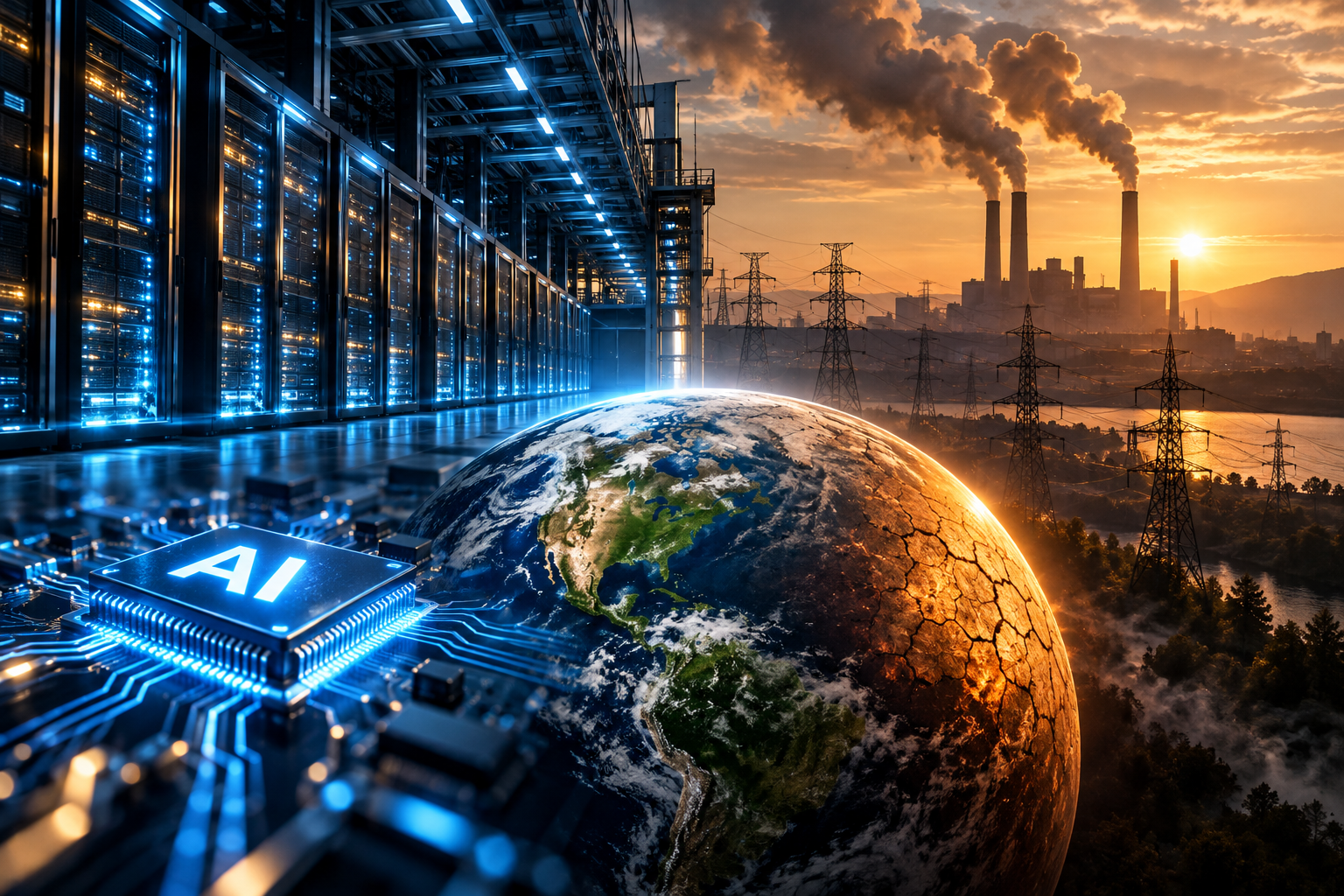
The rapid growth of artificial intelligence is creating an unprecedented demand for electricity. As AI models become more powerful and data centers expand, rising energy consumption could place increasing pressure on power grids, energy resources, and the environment.
The AI Energy Crisis: How Artificial Intelligence Could Reshape the World’s Energy Demand
Artificial intelligence is often presented as one of the defining technologies of the modern era. AI can write, analyze, generate images, discover patterns in massive datasets, assist researchers, and automate tasks that once required hours of human work. But behind every AI response, image, video, or prediction is an enormous technological infrastructure that requires electricity to operate.
As artificial intelligence becomes more powerful and widely adopted, its energy requirements are becoming an increasingly important environmental and economic issue. The servers running AI systems operate inside data centers that require electricity not only to power processors and networking equipment, but also to keep those machines cool and operational around the clock.
The question is no longer simply how intelligent AI can become. It is also how much energy the world will need to supply to support the next generation of AI.
AI Runs on More Than Algorithms
When people interact with an AI system, the experience can appear almost effortless. A user enters a prompt and receives an answer within seconds. Behind that simple interaction, however, powerful computing infrastructure is processing information across specialized chips and servers.
Modern AI models rely heavily on accelerated computing hardware, including graphics processing units (GPUs) and other specialized processors. Training large models can require enormous amounts of computation, while operating those models for millions or billions of users creates a continuous demand for electricity.
The International Energy Agency (IEA) estimates that global data-center electricity consumption was around 460 terawatt-hours (TWh) in 2024. In its base-case projection, electricity consumption from data centers is expected to more than double to around 945 TWh by 2030. The IEA identifies AI as the most important driver of this growth alongside other digital services.
That does not mean AI alone will consume 945 TWh. Data centers also support cloud computing, storage, websites, streaming, enterprise software, and other digital services. However, the rapid growth of AI is becoming one of the major forces behind the expansion of data-center infrastructure.
The Computing Behind Every AI Model
One reason AI has such a significant energy footprint is the sheer amount of computation required by modern models. Training involves processing enormous datasets repeatedly while adjusting billions or even trillions of parameters.
Once a model has been trained, it still requires computing power whenever users interact with it. This process, commonly referred to as inference, happens every time an AI system generates a response, analyzes information, creates an image, produces audio, or performs another task.
As AI becomes integrated into search engines, office software, smartphones, customer-service systems, coding platforms, autonomous technologies, and business applications, the number of AI inference operations could increase dramatically.
This creates an important distinction: AI's environmental footprint is not limited to the electricity required to train a model. The long-term energy demand can also come from operating that model at enormous scale.
Data Centers Are Becoming Power-Hungry Infrastructure
The expansion of AI is driving technology companies to build larger and more sophisticated data centers. These facilities can contain thousands of high-performance computing systems operating simultaneously.
The electricity is needed for much more than the processors themselves. Data centers also require networking equipment, storage systems, cooling infrastructure, backup systems, and other supporting technologies.
The U.S. Department of Energy reported that U.S. data centers consumed approximately 176 TWh of electricity in 2023, representing about 4.4% of total U.S. electricity consumption. The department estimated that data-center electricity consumption could reach between 325 and 580 TWh by 2028, potentially representing 6.7% to 12% of total U.S. electricity use.
AI is not the only factor behind this increase, but the rapid development of AI applications is a significant contributor to the growing demand for computing infrastructure.
Why the Electricity Demand Could Become a Problem
Electricity consumption at a global level is only part of the story. One of the biggest challenges is where data centers are located.
Data centers tend to concentrate large amounts of electricity demand in specific geographic areas. A new facility can therefore place substantial pressure on a local electricity grid even if data centers represent a relatively small percentage of global electricity consumption.
The IEA notes that data-center electricity demand is geographically concentrated, which can make connecting new facilities to electricity grids more challenging. In some regions, grid infrastructure may need to be expanded before new data centers can operate at full capacity.
This creates a potential race between two very different timelines. AI companies can deploy new computing infrastructure relatively quickly, while electricity generation, transmission lines, substations, and other grid infrastructure can take years to plan and construct.
The Environmental Cost Depends on Where the Electricity Comes From
Using electricity does not automatically mean producing the same amount of carbon emissions everywhere. The environmental impact of AI depends heavily on how that electricity is generated.
A data center powered primarily by renewable or nuclear electricity can have a different operational carbon footprint from one relying heavily on coal or natural gas.
The IEA projects that renewables will meet nearly half of the additional electricity demand from data centers through 2030. At the same time, natural gas and other energy sources are also expected to contribute to meeting the growing demand.
This creates a critical question for the AI industry: will the expansion of artificial intelligence be powered by additional clean energy, or will growing electricity demand extend dependence on fossil fuels?
AI's Energy Problem Is Also a Water Problem
Electricity is not the only resource required by large-scale AI infrastructure. Data centers also need cooling systems because high-performance computing equipment generates substantial amounts of heat.
Depending on the cooling technology and local conditions, water can be used as part of the cooling process. As data centers become larger and more numerous, water consumption can become an important consideration, particularly in regions already experiencing water stress.
Technology companies are therefore investing in alternative cooling technologies and water-reuse systems. Microsoft, for example, reports that newer direct-to-chip cooling designs can save more than 125 million liters of water per facility each year compared with conventional approaches.
These developments demonstrate that the environmental impact of AI is not simply a question of electricity consumption. Energy, water, land, construction materials, and electronic hardware are all connected to the expansion of AI infrastructure.
The AI Hardware Cycle Creates Another Environmental Challenge
Artificial intelligence also depends on a rapidly evolving hardware ecosystem. GPUs, AI accelerators, servers, networking equipment, and storage systems are constantly being upgraded as companies seek greater performance and efficiency.
Manufacturing this hardware requires raw materials, semiconductor fabrication, energy, water, transportation, and complex global supply chains. When older equipment is replaced, the industry must also deal with the resulting electronic waste.
Responsible recycling and reuse can reduce some of these impacts. Microsoft, for example, reported that it reused or recycled 90.9% of servers and components in fiscal year 2024. However, the continued expansion of AI infrastructure means that managing hardware waste will remain an important sustainability challenge.
AI's Future Energy Demand Could Be Much Larger
The biggest uncertainty is what happens after today's AI systems become even more widespread.
AI is increasingly moving beyond simple text generation. Generative AI is being applied to high-resolution image generation, video production, speech synthesis, scientific research, software development, robotics, autonomous systems, and increasingly complex reasoning tasks.
These applications can require different amounts of computing power. If AI becomes embedded into billions of devices and services, the total number of computational operations could increase dramatically.
The IEA's projections demonstrate the uncertainty. In its base case, global data-center electricity consumption reaches around 945 TWh by 2030. In a higher-growth scenario, data-center electricity demand could exceed 1,700 TWh by 2035.
That does not mean the higher scenario will necessarily happen. Technological efficiency, AI adoption rates, energy prices, infrastructure constraints, and policy decisions could all change the trajectory. But the range illustrates how difficult it is to predict the eventual energy requirements of AI.
AI Could Also Help Solve the Energy Problem
The environmental story surrounding AI is not entirely negative. The same technology consuming significant amounts of electricity could potentially help make energy systems more efficient.
AI can be used to forecast electricity demand, optimize power generation, detect equipment failures, improve renewable-energy forecasting, manage complex electricity networks, and identify opportunities to reduce energy consumption.
For example, better forecasting can help grid operators balance variable renewable sources such as wind and solar with changing electricity demand. AI can also help companies identify inefficiencies in industrial processes and buildings.
This creates a technological paradox: AI could increase electricity demand while simultaneously helping the energy industry use electricity more efficiently.
The Efficiency Race Will Matter
One of the most important factors determining AI's future environmental footprint will be efficiency.
AI companies are working on more efficient chips, smaller models, improved algorithms, specialized hardware, and better data-center designs. If each AI task requires substantially less computing power over time, efficiency improvements could offset some of the growth in AI usage.
The IEA's analysis specifically considers this possibility. Its high-efficiency scenario projects significantly lower data-center electricity consumption than its base case by 2035, demonstrating how improvements in hardware, software, and infrastructure could influence future demand.
In other words, the future environmental cost of AI will depend not only on how much AI people use, but also on how efficiently that AI can be produced and operated.
Who Will Pay for the Growing Energy Demand?
Building the infrastructure required for the AI economy will require enormous investment. Data centers need electricity generation, transmission capacity, substations, cooling infrastructure, land, semiconductor hardware, and physical buildings.
These investments can create economic opportunities, but they can also raise questions about who ultimately pays for new infrastructure.
If electricity grids must be expanded to accommodate large industrial data centers, policymakers and utilities will need to consider how those infrastructure costs are allocated. They must also balance the interests of technology companies, electricity consumers, local communities, and energy producers.
The issue is therefore larger than a technology company's electricity bill. The rapid expansion of AI could influence energy planning at regional and national levels.
What the AI Industry Needs to Consider
The growth of artificial intelligence does not have to result in an uncontrolled increase in environmental damage. However, sustainability needs to become part of AI infrastructure planning rather than an afterthought.
Companies can reduce the impact of AI by improving computing efficiency, developing lower-power hardware, increasing the use of renewable and other low-carbon electricity, improving cooling systems, recycling hardware, and locating data centers where sufficient energy and infrastructure are available.
Governments and regulators also have a role in ensuring that the growth of data centers does not compromise electricity reliability, water availability, or long-term environmental goals.
The Real Question Is How Fast AI Can Grow Sustainably
Artificial intelligence is unlikely to disappear. The technology is already becoming part of businesses, education, entertainment, research, healthcare, manufacturing, and everyday digital services.
The more important question is how efficiently the world can build the infrastructure required to support it.
The International Energy Agency's projections show that data-center electricity consumption could roughly double between 2024 and 2030. Meanwhile, AI-focused computing is growing even faster than conventional data-center workloads.
That makes energy efficiency, clean electricity, grid expansion, and responsible infrastructure development central issues for the future of AI.
The AI revolution is often described as a digital transformation, but its physical footprint is very real. Behind every model are servers, semiconductor chips, electricity networks, cooling systems, buildings, water resources, and raw materials.
AI may ultimately become one of the most transformative technologies in human history. Whether that transformation can happen without creating an equally significant environmental burden will depend on decisions being made today about how AI is built, powered, and scaled.


