Why Consumers Buy Things They Don’t Need: The Psychology Behind Impulse Buying
Discover why consumers make impulse purchases and how flash sales, FOMO, limited-time offers, and checkout psychology influence buying behavior.
Why Do Consumers Buy Things They Never Planned to Purchase?
Most consumers like to believe that their purchases are the result of careful comparison, rational thinking, and genuine need. In reality, many buying decisions are influenced by emotion, timing, environment, and psychological triggers. An impulse purchase happens when a consumer experiences a sudden urge to buy something without having planned to do so beforehand. Research by Dennis W. Rook in the Journal of Consumer Research helped establish impulse buying as a distinct form of consumer behavior, characterized by a sudden and powerful urge that can override more deliberate decision-making.
Later research by Sharon Beatty and M. Elizabeth Ferrell found that impulse buying is influenced by several factors, including available time and money, shopping enjoyment, browsing behavior, and an individual's tendency toward impulsive purchasing. Their findings show that impulse buying is not caused by a single factor. Instead, it develops from an interaction between the consumer, the shopping environment, and the emotions created during the shopping process.
The Difference Between Need and Want
A useful starting point for understanding impulse buying is the difference between a functional need and an emotionally generated want. A consumer may enter an online store intending to purchase a pair of shoes because their current pair is worn out. While browsing, however, they encounter a jacket that is discounted for a limited time. The jacket was not part of the original plan, but the combination of an attractive product, a discount, and a sense of urgency can create a new desire.
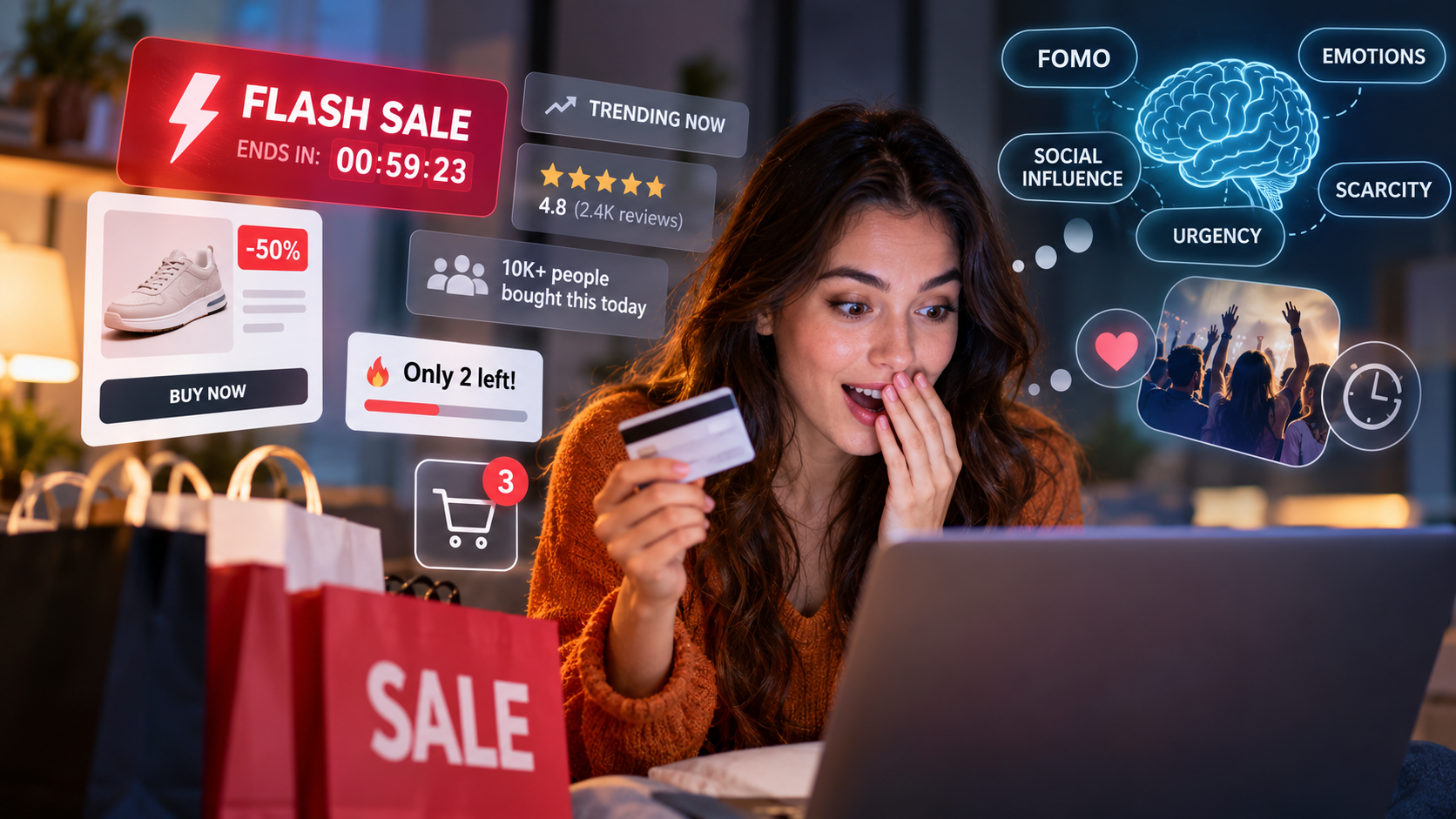
This is where modern retail environments become particularly powerful. Consumers are not simply presented with products; they are surrounded by cues designed to influence attention and accelerate decisions. Product recommendations, promotional banners, countdown timers, personalized offers, social proof, and strategically placed discounts can all change how a consumer evaluates a purchase.
Research on impulse buying suggests that consumers' emotional states and browsing activity can influence whether an urge to purchase ultimately becomes an actual purchase. In other words, the shopping environment itself can help transform a product from something a consumer notices into something they suddenly feel they need.
How Flash Sales Create a Sense of Urgency
Flash sales are one of the clearest examples of how businesses use time pressure to influence consumer behavior. A message such as "50% off for the next two hours" changes the consumer's decision from "Do I need this?" to "What happens if I miss this opportunity?" The product may not have become more useful, but the perceived cost of waiting has increased.
Research published in the Journal of Retailing and Consumer Services has examined how e-commerce promotions influence purchasing behavior, including the effects of promotional timing and discount intensity on consumers. Other empirical research has found that immediate monetary and non-monetary promotions can be associated with impulse buying, while delayed promotional formats may produce different responses.
For marketers, the lesson is important: a promotion is not only about reducing price. The timing and presentation of an offer can change the psychological context in which a consumer makes a decision.
The Scarcity Effect: Why "Only 2 Left" Feels More Valuable
Scarcity is another powerful psychological trigger. Messages such as "limited stock," "limited edition," "only a few remaining," or "sale ends tonight" communicate that an opportunity may disappear. This can make consumers perceive the product as more valuable or make them feel pressure to act before it becomes unavailable.
Marketing research has examined scarcity for decades. Researchers have found that limited-time and limited-quantity claims can stimulate consumer interest under the right conditions. Scarcity can increase the perceived value of an opportunity because consumers may place greater importance on something that appears difficult to obtain.
Marketing researchers have also emphasized that scarcity works differently depending on the situation. A genuinely limited product can create meaningful urgency, while artificial scarcity can eventually damage consumer trust. For this reason, businesses need to distinguish between communicating real limitations and manufacturing pressure simply to force a purchase.
FOMO and the Fear of Missing Out
Scarcity becomes even more powerful when it is connected to social influence. This is where the fear of missing out, commonly known as FOMO, enters the buying process.
FOMO occurs when consumers worry that other people are experiencing something desirable while they are left out. In a shopping environment, that feeling can translate into concern about missing a trend, a discount, a popular product, or an experience that other people are enjoying.
Research published in the Journal of Research in Interactive Marketing has examined how social media influencers can affect purchase intention through social comparison, materialism, and FOMO. Research in this area suggests that imitation of influencers can contribute to social comparison and FOMO, which may then influence consumers' intentions to buy endorsed products.
This helps explain why phrases such as "everyone is buying this," "viral product," or "trending now" can be more influential than a conventional product description. They communicate not only what a product is, but what other people appear to be doing.
Why Checkout Design Can Push Consumers Toward a Purchase
The final stage of the buying journey is also psychologically important. Once a consumer has added an item to a cart, businesses have already invested in getting the customer to that point. The checkout experience can either maintain the momentum of the purchase or give the customer reasons to reconsider.
Research on online shopping cart abandonment has identified factors such as perceived risk, perceived cost, and transaction inconvenience as important influences on whether consumers complete or abandon a purchase. Website usability, clear information, and an effective shopping interface can reduce some of the friction that causes consumers to reconsider their decisions.
Mobile commerce research has similarly identified factors such as shipping costs, product ratings and reviews, platform design, shipping policies, and account fatigue as potential influences on shopping-cart abandonment.
This creates an interesting contradiction in consumer behavior. Marketers work hard to generate excitement and urgency before checkout, but excessive friction during checkout can destroy that momentum. A consumer who was ready to purchase a product moments earlier may change their mind after encountering unexpected costs, complicated forms, or an inconvenient payment process.
Why People Sometimes Buy More After Seeing a Discount
Discounts can also change how consumers evaluate the cost of a purchase. Consider a customer who sees a $100 product reduced to $70. The consumer may focus on the $30 "savings" rather than the $70 they are still spending. If another item is discounted from $50 to $35, adding it to the same order can feel like an additional saving opportunity rather than an additional expense.
This is one reason retailers frequently use percentage discounts, bundles, minimum-spend offers, and free-shipping thresholds. Instead of simply asking consumers to spend money, these techniques frame the purchase around receiving additional value.
Marketing research has also highlighted the growing role of personalized promotions. Retailers increasingly use customer data and loyalty programs to deliver offers based on individual shopping patterns and purchase behavior. When used effectively, personalization can make an offer feel more relevant because the consumer sees it as something specifically suited to their interests.
The Role of Emotions in Impulse Buying
Not every impulse purchase begins with a discount. Sometimes the trigger is emotional. Consumers may shop because they are excited, bored, stressed, entertained, or simply enjoying the shopping experience. Research into impulse buying has found that positive and negative emotional states can form part of the process that leads from shopping conditions to the urge to buy impulsively.
This helps explain why entertainment has become increasingly important in digital commerce. Social commerce, livestream shopping, influencer content, and visually engaging product platforms combine entertainment with purchasing opportunities. Instead of separating "shopping" from "entertainment," these environments merge the two activities into one experience.
When a consumer is entertained while shopping, the mental process can become less focused on whether the product is necessary and more focused on how the product makes them feel at that moment.
When FOMO and Scarcity Go Too Far
Psychological marketing techniques can be effective, but their long-term effects matter. Creating urgency may generate an immediate purchase, but making consumers feel manipulated can damage trust.
Recent research has examined consumers who are particularly prone to FOMO and found that FOMO-based marketing can encourage immediate purchasing while also producing negative emotional or cognitive reactions after the purchase. This suggests that businesses should consider not only whether a tactic increases conversion, but also how customers feel about the brand afterward.
This distinction is important for businesses. There is a difference between communicating a genuine limited-time promotion and manufacturing false scarcity simply to pressure customers. Short-term conversion may be valuable, but sustainable businesses also depend on trust, repeat purchases, and a positive customer relationship.
What This Means for Marketers and Sales Teams
Understanding impulse buying does not mean that businesses should attempt to manipulate every customer into purchasing unnecessary products. Instead, consumer psychology can help marketers understand how people respond to pricing, timing, presentation, social influence, and convenience.
Businesses can use legitimate urgency when an offer genuinely has an expiration date. They can use scarcity when inventory is genuinely limited. They can use social proof when reviews and customer activity are authentic. They can personalize promotions when customer data is used responsibly and transparently. And they can reduce checkout friction by making the purchase process simple and predictable.
The strongest sales strategies therefore combine psychological understanding with real customer value. A discount can attract attention, but the product still needs to justify the purchase. A countdown can create urgency, but the offer needs to be genuine. An influencer can create awareness, but consumers still need a reason to trust the recommendation.
The Psychology Behind the Purchase
Impulse buying is not simply a matter of consumers being careless with money. It is a complex form of consumer behavior shaped by emotion, context, social influence, product presentation, and the design of the buying environment. Research spanning decades shows that impulse purchases can emerge from the interaction between individual tendencies and external shopping conditions.
Modern digital commerce has made these influences more visible and more immediate. A consumer can see a product, watch an influencer recommend it, receive a limited-time discount, see that thousands of people are buying it, and complete the purchase within minutes. The boundaries between discovering a product and deciding to buy it have become increasingly compressed.
That is ultimately why consumers sometimes buy things they do not need. The decision is not always about the product itself. It can be about the excitement of getting a deal, the fear of missing an opportunity, the influence of other people, the emotional reward of shopping, or the simple feeling that waiting means losing something valuable.
For businesses, understanding these psychological mechanisms provides a more useful lesson than simply trying to increase sales. The goal is to understand what moves consumers from attention to interest, from interest to desire, and from desire to action—and to design that journey around genuine value rather than pressure alone.