The Shadow Labs of the Post-War Era: When Science Crossed the Line
Dive into the shocking post-WWII history of covert government bio-experiments, from Unit 731 and Nazi scientist pardons to CIA mind-control projects like MKUltra. Focus Keywords: post-WWII bio experiments, secret government laboratories, Unit 731 immunity, Operation Paperclip history, Project MKUltra CIA, Cold War biological warfare.
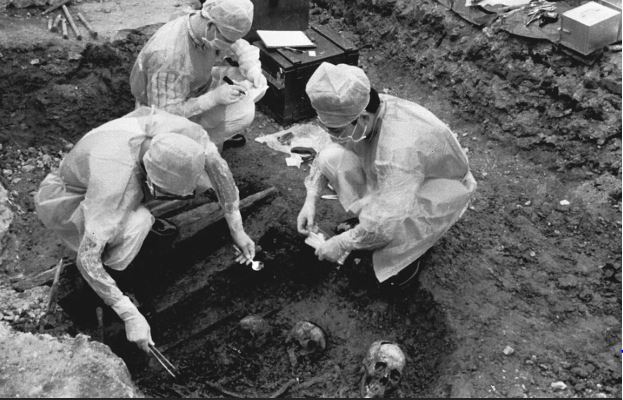
Picture this: The confetti from World War II has barely been swept off the streets. The world is breathing a collective sigh of relief, believing the nightmare of global total war is finally over. But behind closed doors, deep inside underground bunkers, heavily guarded military labs, and sterile academic wings, a brand-new war was quietly spinning up.
Welcome to the paranoid, high-stakes theater of the early Cold War.
If you listen to deep-dive history podcasts, you’ll know that the end of WWII didn't halt scientific advancement—it turbo-charged it. Except, instead of building better cars or curing common ailments, the world’s superpowers turned their microscopes toward something a lot darker: biological dominance, mind control, and weaponized pathogens.
Today, we are peeling back the layers on the most chilling, highly classified bio-experiments conducted in absolute secrecy after 1945. Grab a cup of coffee, settle in, and let’s talk about the science experiments your history textbooks conveniently forgot to mention.
1. The Ultimate Faustian Bargain: Unit 731 and the U.S. Cover-Up
To understand how post-war bio-warfare got so out of hand, we first have to look at the ghost of Unit 731. Operating out of Japanese-occupied Manchuria during WWII, this covert biological and chemical warfare research unit was run by a ruthless Japanese general named Shiro Ishii.
What they did behind the walls of Compound 731 reads like a horror movie script. They didn't just test diseases; they engineered them. They subjected thousands of prisoners—labeled dismissively as "maruta" (logs)—to bubonic plague, anthrax, cholera, forced frostbite, and unspeakable surgical vivisections without anesthesia.
Now, here is where the conspiracy turns into cold, hard geopolitical reality. When the war ended, American intelligence operatives rushed to the scene. Did they lock up the monsters running the show? Not quite.
Instead, the U.S. intelligence apparatus struck a textbook Faustian bargain. General Shiro Ishii and his top scientists handed over thousands of pages of invaluable, albeit horrifying, human experimentation data to the U.S. Army. In exchange? Total immunity from war crimes prosecution. Ishii lived out his life peacefully, and the data vanished into American bio-weapons programs, proving a cynical old adage: in the realm of intelligence, a ruthless asset is worth more than justice.
2. Operation Paperclip and the Transatlantic Pipeline
While the Americans were cutting deals in Asia, they were also running a massive operation in a defeated Germany. Under Operation Paperclip, over 1,600 German scientists, engineers, and doctors—many of whom had direct ties to Nazi atrocities and human testing in concentration camps—were quietly vacuumed up and smuggled into the United States.
They were given new identities, clean slates, and plush laboratory positions within agencies like the Department of Defense and NASA. Why? Because the U.S. was terrified of losing the technological and biological arms race to the Soviet Union.
These researchers brought with them advanced insights into chemical compounds, poison gasses, and high-altitude survival limits. When you start pulling on the thread of Operation Paperclip, you realize that the boundaries between Allied victory and Axis capability blurred almost overnight. The minds that designed the camps were suddenly designing America's Cold War defense strategy.
3. Project MKUltra: The CIA’s Search for the "Manchurian Candidate"
Fast forward to the early 1950s. The Korean War is raging, and reports start filtering back to Washington that American POWs captured by Chinese and North Korean forces are returning completely "brainwashed," reciting communist propaganda with eerie compliance.
Panic ensued in Langley. The CIA became utterly convinced that the Communist bloc had unlocked the secrets of absolute mind control. Their response? Project MKUltra.
Authorized in 1953 by CIA Director Allen Dulles and spearheaded by chemist Sidney Gottlieb, MKUltra was a sprawling, illegal umbrella project designed to figure out how to manipulate human mental states, alter behavior, and create the ultimate interrogation "truth serums".
- The LSD Experiments: The CIA covertly dosed unsuspecting civilians, prison inmates, and even their own agents with massive doses of hallucinogens to test the limits of ego dissolution and compliance.
- Sub-Projects and Fronts: Over 80 institutions—including universities, hospitals, and pharmaceutical companies—received secret funding. Doctors like D.E. Cameron in Canada utilized "psychic driving" (looping tape recordings into patients' headphones for days) and electroshock therapy to entirely "depattern" human minds, attempting to wipe clean a personality and rebuild it from scratch.
When the program was finally exposed by the Church Committee in the 1970s, the CIA tried to cover its tracks by shredding thousands of files. What survived gave the public a terrifying glimpse into a world where citizens were treated as laboratory mice in the name of national security.
4. Project SHAD and the Open-Air Germ Games
If you think the government only experimented behind closed doors in dark rooms, think again. During the 1960s and 1970s, the U.S. military launched Project SHAD (Shipboard Hazard and Defense) alongside a series of open-air testing programs like Project 112.
The goal? To figure out how vulnerable American warships and troops were to real-world biological and chemical attacks. To test this, they didn't use computer simulations. They sprayed live, active chemical and biological agents—including nerve gases like VX and Sarin, and bacteria meant to mimic anthrax—over active U.S. Navy ships carrying thousands of unsuspecting American sailors.
Sailors were told it was a routine training exercise. Years later, many of these veterans developed chronic, unexplained illnesses, rare cancers, and psychological disorders, fighting a multi-decade legal battle just to get the government to acknowledge that they were used as unwitting test subjects.
The Legacy of the Shadows
When you stitch all these pieces together, a wild picture emerges. The post-world-war era wasn't just an era of rebuilding; it was a golden age of clandestine science where ethical red lines were systematically erased.
From the protected files of Unit 731 to the psychedelic fog of MKUltra and the chemical mists of Project SHAD, governments proved time and time again that in the grand chessboard of global supremacy, individual human lives were often viewed as nothing more than acceptable collateral damage.
It makes you wonder: if this is what they declassified and admitted to decades later, what kind of science is happening in the shadows today?