A Grieving Husband. A Cover-Up. A Weapon of War Turned on the People Who Lied to Him.
Book Feature · Military Thriller / Horror
A Grieving Husband. A Cover-Up. A Weapon of War Turned on the People Who Lied to Him.
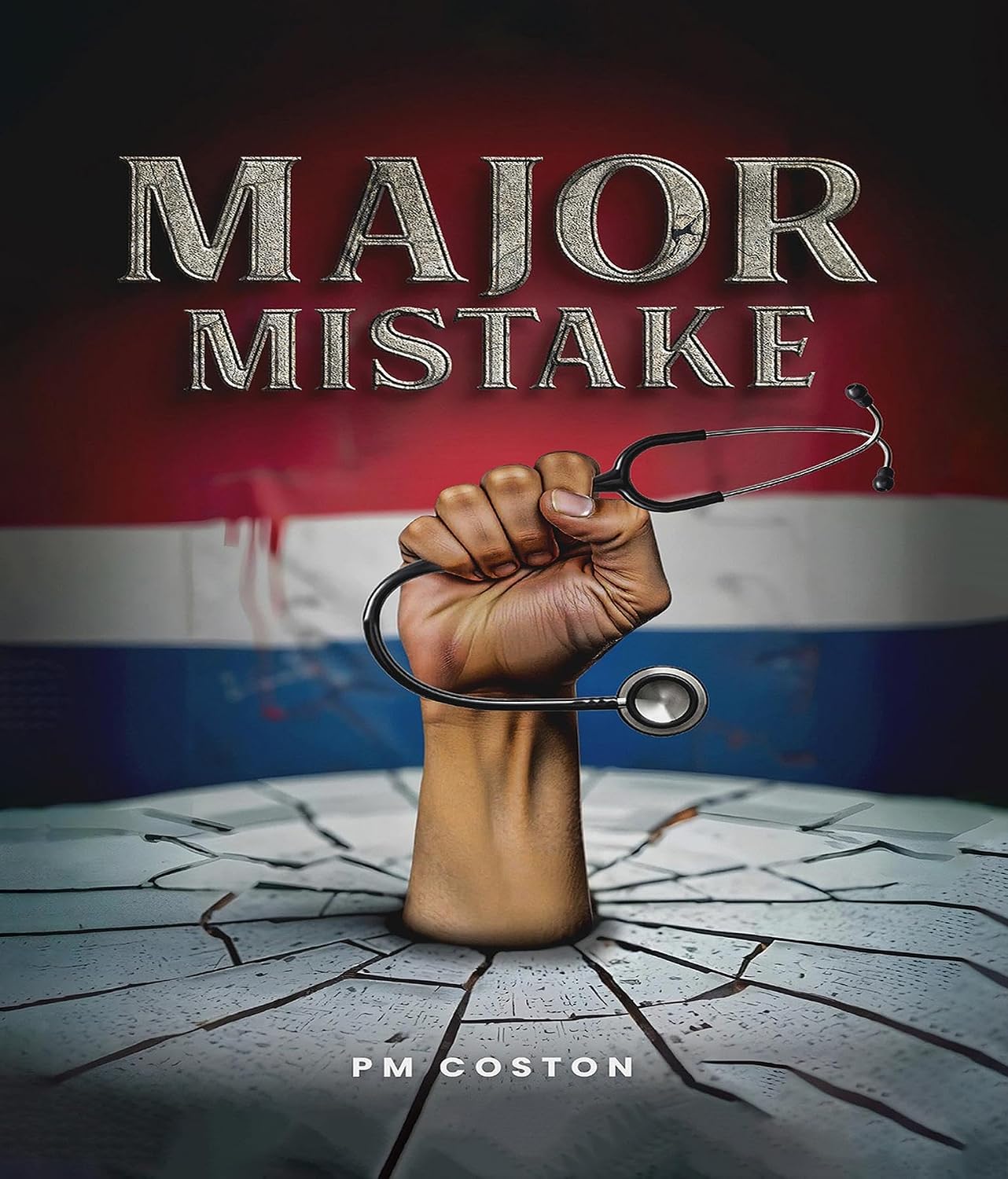
Inside the terrifying world of Major Mistake by P.M. Coston
There's a particular kind of horror that doesn't come from ghosts, or demons, or things that go bump in the night. It comes from something far more plausible, and far more disturbing: a man who has already killed for his country, trained to be invisible, trained to make things disappear — and who has just been handed a reason to turn every one of those skills on the people responsible for his wife's death.
That is the premise of Major Mistake, the gripping military thriller from author P.M. Coston, and it's a premise that gets under your skin precisely because none of it feels impossible. This isn't a monster movie. It's worse. It's a story about what happens when institutional arrogance, medical negligence, and a cover-up collide with a man who has spent over two decades learning how to build, defuse, and deploy some of the most lethal devices on earth — and who has just lost the one person who made him human.
If you're the kind of reader who loves horror rooted in real-world dread — the slow-building terror of knowing that the monster in this story could be standing next to you in line at the grocery store, could be wearing a uniform, could be someone everyone else calls a hero — Major Mistake is going to leave a mark.
It Begins With a Lie
The opening pages of Major Mistake introduce us to Master Sergeant Thomas Michael Dunn on what should be the worst day of his life for one reason, and instead becomes the worst day of his life for an entirely different one. His wife of twenty-five years, Diane, has just died in surgery at an Air Force hospital — a routine procedure to check for breast cancer that should never have ended in a body bag.
The official explanation is heartbreakingly simple: an allergic reaction to anesthesia. Tragic. Unavoidable. Nobody's fault.
Dunn doesn't believe a word of it.
And he's right not to. Through an inside source — someone within the hospital brave enough, or reckless enough, to leak the truth — Dunn learns that the surgical team didn't use the medication listed on the official report. Instead of the prescribed anesthetic, an uncertified member of the surgical team administered a synthetic opioid many times more powerful than morphine, paired with additional opioid analgesics — a combination so dangerous it functions less like medicine and more like a loaded gun pointed at a sedated woman's chest. The drugs were stored improperly, on the same shelf, in bottles that could be mistaken for one another by anyone not paying close enough attention. And on the day Diane went into surgery, someone wasn't paying close enough attention.
What follows is one of the most chilling scenes in the book: a confrontation between Dunn and the Hospital Commander, a Brigadier General who tries — clumsily, arrogantly — to manage a grieving husband the way he'd manage a difficult subordinate. He offers Dunn paperwork instead of answers. He offers procedure instead of accountability. And when Dunn produces his own copy of the surgical notes — a copy someone inside the hospital risked their career to hand him, with the falsified drug name crossed out and the real one written in — the general tries to physically take it from him.
That single gesture — a powerful man trying to seize the one piece of truth a grieving husband has left — is the moment Major Mistake stops being a story about grief and becomes a story about war. Because Dunn doesn't hand the paper back. He puts the general's arm in a lock, takes back what's his, and walks out with four words that will echo through the rest of the novel like a death sentence: You made a mistake.
The Most Dangerous Man in the Room Is the One Nobody Notices
What makes Major Mistake so unnerving isn't just the premise — it's the character at its center. Thomas Michael Dunn isn't your typical grieving-widower-turned-vigilante. He's something far more unsettling: a highly trained Explosive Ordnance Disposal specialist with more than two decades of experience defusing improvised explosive devices across some of the most dangerous conflict zones on earth. A man who can reportedly identify plastic explosives by touch alone. A man with graduate degrees in engineering and the sciences. A man who has intentionally sabotaged his own promotion tests for years — not out of laziness, but because he understands that a lower rank means less scrutiny, and less scrutiny means more room to operate in the shadows.
And here's the detail that turns this book from a revenge thriller into genuine psychological horror: Dunn isn't a good man pushed to the edge. He's a deeply damaged one — the novel doesn't shy away from naming him, in blunt clinical terms, as someone whose emotional wiring was never right to begin with. Someone who moves through the world performing warmth and normalcy the way another man might perform a job he's grown bored with. He has hurt people before. He has done terrible things in the name of duty. His grief over Diane is real — arguably the only fully genuine emotion left in him — but it doesn't transform him into a hero. It removes the last thin restraint that was keeping something far more dangerous in check.
That's the true horror at the heart of Major Mistake: not a supernatural entity, but a fully human one — trained, capable, connected, and now completely unleashed, hiding in plain sight behind a shined pair of shoes and a military haircut, indistinguishable from every other soldier walking across base. The people who wronged him have no idea what's coming. Neither, really, do the people around him who have nothing to do with any of it.
A Farmhouse Full of Death
Coston doesn't waste time easing readers into the danger. Within the first several chapters, Dunn has already stolen a communications van and a commander's car directly off base, evaded a manhunt, and retreated to an isolated farmhouse he shares with — and this detail lands with real weight given what we now know about him — a hidden arsenal that would make a small militia jealous.
What was supposed to become a wine cellar, a small dream he and Diane once shared for their future together, has instead become something else entirely: a concealed weapons cache stocked with military-grade rifles, ammunition modified to fragment devastatingly on impact, high-powered night optics, and explosive materials accumulated — we learn with mounting dread — over the better part of a decade, quietly siphoned from every base, post, and deployment he's ever served at, hidden right under the noses of the same superiors who kept giving him medals.
There's a sequence early in the book where Dunn, hiding in his barn workshop with a loaded automatic rifle cradled in his arms, watches two local police officers casually search his property, completely unaware that a man capable of ending both their lives without hesitation is close enough to touch. It's a masterclass in tension — the officers joke with each other, oblivious, while Dunn calculates ranges and angles, coldly weighing whether killing them would be "a waste of ammo." The scene resolves without bloodshed, but the fact that it even had to resolve — that we, the reader, genuinely aren't sure it won't end in gunfire — tells you everything about the kind of dread Coston is building here. This isn't a book that keeps its monster at arm's length. It puts you inside the monster's head and asks you to sit there.
And in that hidden room — his "temple," as the book describes it, a space soaked in cordite and gun oil where Dunn goes to find peace — we get one of the novel's most disturbing passages: a man who has assigned near-religious significance to his weapons, who speaks to his dead wife about the God he no longer believes will forgive him, and who accepts, almost serenely, that he is about to become something irredeemable in service of the only thing he has left to protect — her memory, and the punishment of the people who took her from him.
An Institution Circling the Wagons
What elevates Major Mistake above a simple revenge story is how unflinchingly it portrays the machinery of institutional self-preservation kicking into gear the moment the truth threatens to surface. As Dunn disappears into the shadows to plan his retribution, the hospital command staff isn't focused on justice, or even damage control in any meaningful sense — they're focused on finding and silencing whoever leaked the surgical records to him, protecting careers, and burying the truth so deep it can never resurface.
Readers watching this unfold will find themselves in a genuinely uncomfortable position: rooting, on some level, for a man they know is dangerous, simply because everyone arrayed against him is so thoroughly, infuriatingly corrupt. Coston builds an entire ecosystem of flawed, self-interested characters — commanding officers more concerned with their own advancement than the truth, medical staff protecting each other's certifications and reputations, a bureaucracy built to absorb and neutralize accountability before it ever reaches the people responsible. It's a chillingly familiar dynamic to anyone who has ever watched an institution protect itself instead of the people it failed, and it's precisely what makes Dunn's rampage — however monstrous — feel, at moments, almost inevitable.
As the manhunt for Dunn intensifies — pulling in the Air Force Office of Special Investigations, the Secret Service, local police, and a growing web of terrified officials trying to contain a scandal that keeps threatening to swallow careers whole — the novel widens into something closer to a full-scale thriller, without ever losing the intimate, personal horror of its opening chapters. Every new character who enters Dunn's orbit becomes a potential target, a potential witness, or a potential casualty. Nobody in this book is safe simply by virtue of being innocent.
Why Horror Readers Should Not Sleep On This Book
If your idea of horror starts and ends with haunted houses and supernatural entities, Major Mistake might not look, at first glance, like it belongs on your shelf. But readers who understand that the most effective horror often has nothing to do with the supernatural — that the scariest stories are the ones that feel like they could be ripped from tomorrow's headlines — will find something genuinely unsettling here.
This is a book about how thin the line really is between the people we trust with our lives — doctors, generals, institutions — and catastrophic, life-ending failure. It's a book about what happens when that failure is covered up instead of confronted. And most disturbingly, it's a book about how easily a person trained by the very institutions meant to protect us can become the most efficient, terrifying weapon imaginable, once turned in the wrong direction.
Coston writes with an unflinching, almost forensic attention to detail — from the mechanics of the weapons Dunn wields to the suffocating bureaucracy of a military hospital trying to protect itself — that gives the entire novel a disturbing sense of authenticity. This isn't cartoonish violence. It's precise, deliberate, and delivered by a character whose competence is exactly what makes him so frightening. You don't fear Thomas Michael Dunn because he's unpredictable. You fear him because he is exactly as predictable, and exactly as effective, as twenty-two years of training made him.
By the time the story reaches its final chapters — a tense, unresolved flight toward an uncertain future involving false identities, a hidden pregnancy, and the looming threat of the very people who first tried to control him — Major Mistake has stopped feeling like fiction and started feeling like a warning. About institutions. About the people we trust blindly. And about what happens when the wrong person is pushed past the point of no return, and simply... disappears into a system built to help him do exactly that.
If you're a horror or thriller reader looking for something that will actually keep you up at night — not because of what might be hiding in your closet, but because of what might be sitting three cubicles away from you at work, or standing next to you in a hospital hallway wearing a uniform and a calm, practiced smile — Major Mistake deserves a place at the top of your reading list.
Ready to step inside Michael Dunn's world?