Nuclear Fusion Is Getting Closer — Could It Really Power the World?
Nuclear fusion could provide abundant low-carbon energy by recreating the reaction that powers the Sun. With recent breakthroughs in fusion research, how close are scientists to turning this promise into a practical source of electricity?
Nuclear Fusion Is Getting Closer — Could It Really Power the World?
For decades, nuclear fusion has been described as one of the most promising possibilities for the future of energy. The process powers the Sun, producing enormous amounts of energy by combining light atomic nuclei. If scientists can reproduce fusion on Earth in a controlled and economically practical way, it could transform the global energy system.
Recent advances have made fusion research increasingly exciting. Scientists have achieved important milestones in both magnetic-confinement and laser-driven fusion experiments. But producing fusion in a laboratory is only one part of the challenge. The much bigger question is whether engineers can turn those scientific achievements into reliable, affordable power plants.
What Is Nuclear Fusion?
Nuclear fusion occurs when two light atomic nuclei combine to form a heavier nucleus. Under extremely high temperatures and pressures, hydrogen isotopes can fuse and release energy.
The Sun has been carrying out this process for billions of years. Its enormous gravity creates the conditions needed for fusion in its core.
On Earth, scientists cannot simply reproduce the Sun's enormous pressure. Instead, fusion experiments use extremely high temperatures and sophisticated technologies to create and control a plasma — a superheated state of matter in which atoms are separated into nuclei and electrons.
Why Is Fusion So Difficult?
One of the biggest challenges is temperature. Fusion fuel must be heated to extraordinarily high temperatures so that atomic nuclei have enough energy to overcome their electrical repulsion and collide.
At these temperatures, the fuel becomes plasma. But plasma is extremely difficult to control.
Scientists need to keep the plasma hot and stable long enough for fusion reactions to occur while preventing it from damaging the surrounding equipment.
This is why fusion research requires enormous superconducting magnets, specialized materials, powerful lasers, advanced sensors, and sophisticated computer systems.
Tokamaks: Creating a Tiny Artificial Sun
One of the best-known approaches to fusion uses a machine called a tokamak.
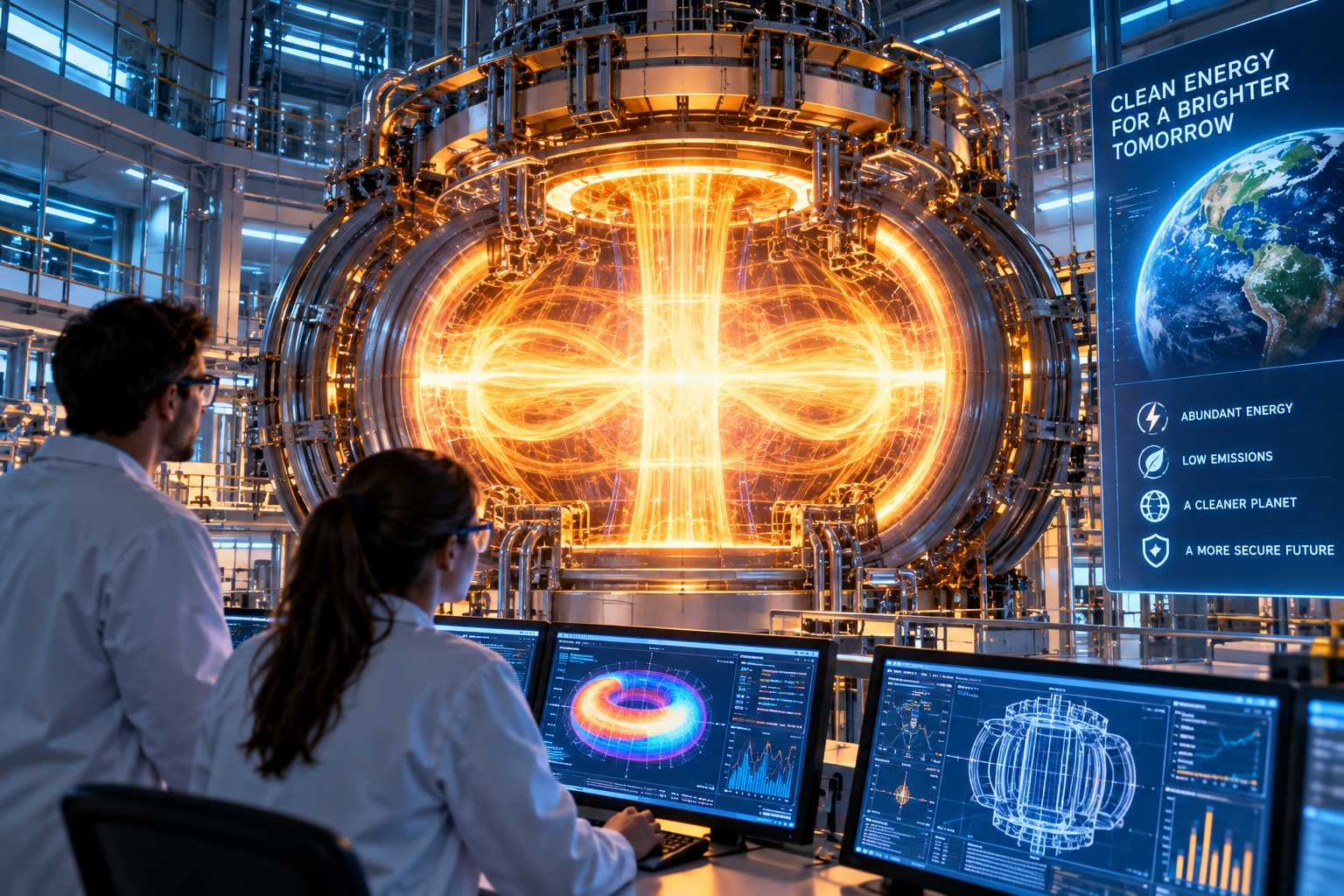
A tokamak is a doughnut-shaped device that uses powerful magnetic fields to confine extremely hot plasma. The magnetic field prevents the plasma from directly touching the walls of the reactor.
Large international projects are using tokamak technology to investigate whether sustained fusion reactions can eventually become practical.
The challenge is not simply achieving a fusion reaction. A future commercial reactor would need to operate reliably, repeatedly, and economically while producing substantially more usable energy than the entire system consumes.
Laser Fusion Takes a Different Approach
Magnetic confinement is not the only way scientists are pursuing fusion.
Inertial confinement fusion uses powerful lasers to rapidly compress a tiny fuel capsule. The compression creates extreme temperatures and pressures that can trigger fusion.
Experiments using this approach have produced important results and demonstrated that fusion ignition is scientifically possible under carefully controlled conditions.
However, a laboratory demonstration is very different from a commercial power station. A practical facility would need to repeat the process efficiently and frequently while generating enough electricity to justify the enormous infrastructure required.
Why Scientists Are So Interested in Fusion
Fusion has several characteristics that make it attractive as a potential energy source.
The fusion reactions being investigated can use hydrogen isotopes as fuel, and some of these materials are widely available. Fusion also does not produce carbon dioxide during the fusion reaction itself.
Unlike conventional nuclear fission reactors, fusion does not rely on maintaining a chain reaction. If the conditions required for fusion are disrupted, the reaction stops.
Fusion reactors would still produce radioactive materials and would require careful management of activated reactor components and other radioactive materials. It is therefore not accurate to describe fusion as completely free of radioactive waste.
How Close Are We to Fusion Power?
This is where expectations need to be realistic.
Scientists have demonstrated major advances in fusion research, but a commercially viable fusion power industry does not yet exist.
Researchers still have to solve several difficult engineering problems, including maintaining stable plasma, developing materials that can survive extreme conditions, producing and handling fusion fuel, removing heat efficiently, and designing systems that can operate economically for long periods.
A successful fusion experiment therefore does not automatically mean that electricity from fusion is ready for homes and businesses.
The Biggest Engineering Challenge
One of the hardest problems is building materials capable of surviving inside and around a fusion reactor.
Fusion reactions can produce high-energy neutrons that interact with reactor components. Over time, these particles can damage materials and change their physical properties.
Future reactors will need components capable of withstanding intense heat, radiation, and mechanical stresses while remaining reliable enough for repeated operation.
Could Fusion Replace Other Energy Sources?
Even if commercial fusion becomes possible, it would not necessarily replace every other form of energy generation.
Electricity systems are likely to continue using a combination of technologies. Solar and wind power, energy storage, nuclear fission, hydroelectricity, geothermal energy, and other technologies can all play different roles depending on geography, infrastructure, cost, and energy demand.
Fusion could potentially become another major source of electricity if researchers can overcome its technical and economic challenges.
Why Fusion Could Matter for the Future
The world's demand for electricity is expected to continue growing as transportation, industry, computing, and other sectors become increasingly electrified.
A successful fusion power plant could potentially provide a concentrated source of electricity with low direct carbon emissions and fuel that is relatively abundant compared with some conventional energy resources.
But the technology must first demonstrate that it can produce electricity reliably and at a competitive cost.
The Future of Nuclear Fusion
Nuclear fusion has moved from a purely theoretical dream toward an increasingly active engineering field. Scientific experiments have demonstrated important pieces of the puzzle, but many pieces still need to come together.
The next stage of fusion research will be about more than simply creating hotter plasma or achieving impressive laboratory results. Scientists and engineers must demonstrate sustained operation, efficient energy production, durable materials, reliable fuel systems, and practical economics.
Fusion may not arrive as quickly as its biggest promises suggest, but the progress of recent years has made the question more serious than ever: can humanity eventually build an artificial star that powers the world?