Dr. Naeem Meo's DARK POWER and POWERPLAY Series: The Complete Reading Guide to Every Book
A retired physician turned thriller author, Dr. Naeem Meo exposes corruption in courtrooms, hospitals, and governments. This spoiler-free guide covers every book in his DARK POWER and POWERPLAY series, including the reading order and the best place to start.
Where Fiction Challenges Power: A Reader's Guide to Dr. Naeem Meo's DARK POWER and POWERPLAY Series
Some thriller writers build their stories from research. Dr. Naeem Meo builds his from experience. He is a retired physician turned American author, and he spent years inside the systems he now writes about: hospitals, insurance networks, federal courts, and the machinery that decides who gets protected and who gets punished. That background gives his fiction an unusual edge. His villains are rarely lone madmen. More often, they are institutions, and the people who have learned to hide behind them.
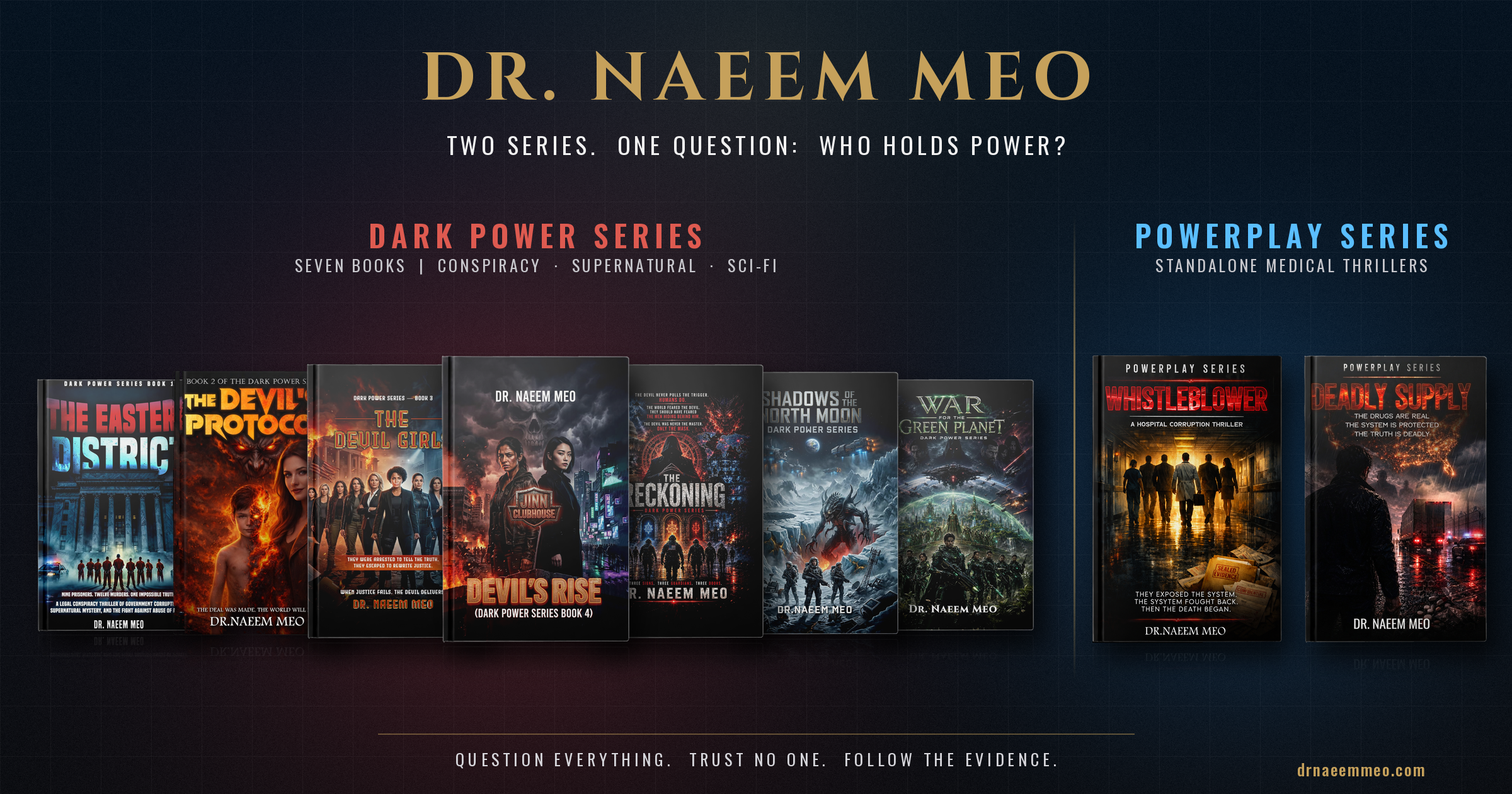
Dr. Meo writes across two very different series. DARK POWER is a sprawling saga that begins as a courtroom crime thriller and grows, book by book, into a global conspiracy with supernatural and science-fiction elements. POWERPLAY stays firmly in the real world, with grounded medical and political thrillers that expose corruption inside American healthcare, the pharmaceutical industry, and the drug trade.
The two series differ in scale, but they ask the same question: who holds power, and what happens when nobody holds them accountable? This guide covers both series and every book in them, without spoilers, so you can decide where to begin.
The DARK POWER Series
What the Series Is About
DARK POWER opens as a murder mystery set in a Missouri federal courtroom. By the seventh book it has reached the Moon and a distant world beyond it. That journey sounds unlikely on paper, but it follows a clear idea. Each book widens the lens. What starts as corruption inside one court district becomes a conspiracy that touches intelligence agencies, world governments, technology platforms, and eventually humanity's future among the stars.
At the center of it all is a mysterious force known as Iblis, drawn from the figure of the Devil in Islamic tradition. The series never presents this as a religious work. Dr. Meo uses the supernatural as a mirror. In an early note to readers, he suggests that societies often blame devils and dark forces for their suffering, while the real devils are frequently human beings who abuse power. Throughout the series, readers are left to wonder where the supernatural ends and human manipulation begins. That uncertainty is one of its strongest hooks.
Readers who enjoy Dan Brown's puzzles, Tom Clancy's intelligence operations, or the global scale of James Rollins will find familiar pleasures here, blended with legal drama, horror atmosphere, and speculative fiction.
Book 1: The Eastern District
The series begins on a quiet Sunday afternoon in St. Louis. District Attorney Dorothy Brown, a feared federal prosecutor who never lost a case, is found dead inside her fortified home. There is no forced entry, no struggle, no blood. Her body sits upright at her desk, her neck broken, and beside her lies a handwritten note confessing to abuse of power.
FBI Agent Gerald Hunter has worked hundreds of homicides, but nothing like this. Brown's record troubles him even before her death. Almost every case she handled ended in a plea deal, and many of the defendants were foreign-born doctors, pharmacists, and healthcare workers charged with fraud. Then more officials connected to the Eastern District die in the same impossible way, and the evidence points toward the Marion Federal Prison Camp, where many of those convicted professionals are serving their sentences.
That raises the book's central riddle. How could men locked behind prison walls be connected to killings across four states? As the investigation builds toward an extraordinary Supreme Court hearing, with defense attorney Ashley Smith and a quietly remarkable inmate named Dr. Ahmad Khan at its heart, The Eastern District works as both a gripping legal thriller and a sharp critique of plea bargaining and wrongful prosecution. It also plants the first seeds of something darker. This is the natural starting point for the series.
Book 2: The Devil's Protocol
The second book begins where the first one's victory turns sour. A man who once made a desperate bargain to save his fellow inmates dies alone in his living room, and Dr. Khan understands that the bargain was never really settled. A dark presence wants something from a young man named Danny, and it will stop at nothing to get it.
What follows is the series' most openly supernatural chapter. A beautiful stranger appears on a foggy Missouri highway, a church burns, and a cold, patient evil begins to build something new in the world. As the threat spreads from rural Missouri into global systems, world powers form a Global Counter-Iblis Task Force. Here readers meet Aadil, a CIA and Pentagon liaison who becomes one of the series' key figures.
The Devil's Protocol is where DARK POWER shifts from mystery to war. It blends small-town horror with military and cyber operations, and it raises a chilling idea: what if the decline of faith and the rise of digital addiction are not accidents, but a strategy?
Book 3: The Devil Girls
Eleven women from eleven different nations are transported under heavy guard to a secret federal detention facility in Oklahoma. The government accuses them of helping Iblis Jr. manipulate markets, infrastructure, and belief systems through digital subversion. Among them is Sam, a former cyber-engineer who has barely spoken since her arrest. When she finally does, she asks for one person: attorney Sadaf Chaudhary.
The Devil Girls returns to the courtroom drama that made the first book so strong, but on a much larger stage. The trial becomes a media storm, and the women use the witness stand to put the government itself under scrutiny, raising questions about manufactured wars, hidden alliances, and how power protects itself through narrative. Readers are left to judge for themselves whether the Devil Girls are victims, believers, or something more complicated.
This book is the turning point of the saga. It asks readers to consider whether the "devils" and the governments hunting them are really so different.
Book 4: Devil's Rise
The movement goes global. The Devil Girls arrive in India, welcomed in the ancient city of Ayodhya, with a mission far larger than anything they attempted in America. Among them is Pooja, whose personal history in India gives this book its emotional core.
Devil's Rise is the most geopolitical entry in the series. The story moves from Geneva summits to the Oval Office, from RAW headquarters in New Delhi to secret Politburo meetings in Beijing, as the world's intelligence services, including fictionalized versions of the CIA, Mossad, and China's MSS, scramble to respond. Assassinations, cover-ups, and backroom deals pile up as three nuclear powers find themselves negotiating with a force they cannot defeat.
At its heart, the book asks what happens when people lose faith in justice so completely that they accept revenge dressed up as reform. It is fast, sweeping, and deliberately unsettling.
Book 5: The Reckoning
With the Devil's influence accelerating, Aadil takes the lead in the series' most puzzle-driven installment. He partners with Hafiz Yasser, a cybersecurity expert who is also a scholar of sacred knowledge, and with an operative named Jeff. Together they chase a mystery that runs from the digital skeleton of the JINN Network to ancient signs hidden in the world's holiest cities.
The Reckoning is the closest the series comes to a Dan Brown-style treasure hunt. The trail runs through Istanbul, Makkah, Jerusalem, and Rome, and involves three mysterious doors, a forbidden genetic sample, and a shadowy figure known only as MB. Meanwhile, an international task force assembles in Riyadh, and the question of who is truly pulling the strings finally comes into focus.
This book closes the first major arc of DARK POWER and sets the stage for the dramatic shift that follows.
Book 6: Shadows of the North Moon
The series now crosses into science fiction. One morning, every screen on Earth announces the launch of a new social platform called MOON: free forever, no rules, no restrictions, only pleasure. Within hours, a billion people have signed up, and the world realizes the devils never left. They simply came back with a better product.
That opening alone is one of the sharpest satirical ideas in the series. But the book quickly heads toward the real Moon, where vast untapped wealth, including gold, titanium, and helium-3, sets off a trillion-dollar race between the United States, China, and India. Secret cloning facilities, betrayals at the highest levels of government, and an ancient enemy living on the lunar surface known as the Shadows turn the Moon into a battlefield.
Shadows of the North Moon is the longest and most cinematic book in the series. Its central question stands out even amid the spectacle: what if humanity's greatest discovery becomes its greatest mistake?
Book 7: War for the Green Planet
The newest book opens with a crash. A damaged spacecraft tears through an unfamiliar atmosphere and slams into a world bathed in green light. Ten survivors from Earth, including Aadil, Jeff, and a team of scientists and soldiers, stumble out of the wreckage and are immediately surrounded by armored troops who speak perfect English. Their first words to the survivors are a formal arrest.
What the survivors discover on the Green Planet is a civilization more advanced than Earth, but also healthier, more disciplined, and more united. As war threatens this world too, War for the Green Planet becomes both a military science-fiction adventure and a thoughtful comparison between two societies. The survivors, and the reader with them, start asking what Earth could learn from a world that made different choices.
It is the most reflective book in the series, and it shows how far DARK POWER has traveled from that single impossible murder in St. Louis.
The POWERPLAY Series
What the Series Is About
If DARK POWER uses the supernatural to talk about power, POWERPLAY removes the metaphor entirely. These are grounded, realistic thrillers set inside the American systems that affect ordinary lives most directly: hospitals, drug companies, insurance, and the war on drugs.
Each book stands on its own, with its own cast and story, so readers can start with whichever subject interests them most. What connects them is a pattern Dr. Meo returns to again and again. Accountability in America tends to flow downward. Individual doctors and small players get punished, while the institutions that design the incentives stay protected. POWERPLAY books are about the ordinary people who decide to push back.
This is where Dr. Meo's medical background is most visible. The clinical details, the insurance maze, and the hospital hierarchy all feel authentic because the author has lived inside them.
Whistleblower
John Johnson is sixty years old, a high school math teacher for three decades, and the kind of man who has always believed the system will do right by him if he follows the rules. When mild chest pain sends him to a respected hospital for routine tests, he wakes up to doctors insisting he needs immediate open-heart surgery. Before his family can review the results or even make a decision, he is rolled into the operating room.
Then a cath lab technician named Jennifer looks at his images more closely and sees something that does not add up.
Whistleblower follows Jennifer, John's daughter Amanda, his son David, a young cardiology fellow, and others who begin to suspect that what happened to John was not a mistake but a business model. With the help of a former federal prosecutor turned whistleblower attorney, they take on a powerful hospital system, and they soon learn how far such institutions will go to protect themselves.
The opening chapter is one of Dr. Meo's most effective. Anyone who has ever felt rushed or powerless in a hospital will recognize it immediately. The book is both a tense legal thriller and a clear-eyed look at the gap between medical care and medical profit.
Triple Blind
Subtitled A Pharma Thriller Where Data Lies and People Die, this book takes readers inside the pharmaceutical industry. Dr. Erika starts her dream job at RPN Pharmaceuticals in New Jersey just as the company races to launch OMJ, a groundbreaking oral weight-loss drug with a triple mode of action. Being first to market is worth billions, and the drug moves through approval at remarkable speed.
As Erika settles into her new role, she begins opening the "black box" of the company's clinical data, and the numbers start telling a different story from the one presented to regulators. Working alongside allies including Margaret and Morgan, she is pulled into a fight that stretches from trial data to Washington dinner tables to the real question behind every prescription: who actually sets the price of a pill, and why?
Triple Blind is a sharp, timely read, especially as weight-loss drugs dominate headlines. It balances corporate intrigue with genuine hope that the system can change when a few people refuse to look away.
Deadly Supply
Sergeant Marcus D. Williams has spent years watching overdose numbers climb across West Virginia. He knows the statistics by heart. Then, in the middle of yet another briefing, his wife calls: their seventeen-year-old son, Ryan, has overdosed.
Deadly Supply is the most personal book in POWERPLAY. Driven by what happened to his own family, Marcus teams up with Special Agent Kate Monroe and an old friend with a complicated past, Tom Caldwell, to follow the fentanyl, meth, and opioid trade back to its source. What they find is not a single cartel boss but a layered network of cartels, shell companies, corrupt officials, and legitimate businesses, all built to survive any single loss.
The book is more than a manhunt. It imagines a new approach to the crisis, one that treats addiction with prevention and treatment instead of punishment alone. That combination of hard-edged investigation and real hope makes Deadly Supply a strong finish to this set of POWERPLAY stories.
Where Should You Start?
For DARK POWER, start with The Eastern District and read in order. Each book builds directly on the last, and part of the pleasure is watching the story grow from a local murder mystery into a global and then interplanetary saga. Readers who prefer grounded crime fiction will likely love the first and third books most. Those who enjoy conspiracy, intelligence thrillers, and science fiction will find the later books especially rewarding.
For POWERPLAY, start anywhere. Each book stands alone, so choose the topic that matters most to you: hospital fraud in Whistleblower, pharmaceutical corruption in Triple Blind, or the drug crisis in Deadly Supply.
Readers who enjoy both kinds of story will notice how the two series speak to each other. POWERPLAY shows corruption as it really happens, in ordinary buildings, to ordinary people. DARK POWER asks what that same corruption would look like if it had a face, a plan, and no limits.
About the Author
Dr. Naeem Meo is a retired physician and an American author of political, medical, and conspiracy thrillers. His work draws on a long career inside the healthcare system and a lasting interest in how institutions use and misuse power. His books are written to entertain, but also to leave readers with uncomfortable questions they keep thinking about after the final page.
His guiding message sums up both series well: question everything, trust no one, and follow the evidence.
Discover Dr. Naeem Meo's Books
Explore the complete collection of Dr. Naeem Meo's thrillers and discover the stories behind DARK POWER and POWERPLAY.
To learn more about Dr. Naeem Meo and his books, visit drnaeemmeo.com.