AI Can Now Write Code. So What Happens to Software Developers?
AI coding tools are changing how software is designed, written, tested, and maintained. As artificial intelligence becomes capable of generating working code, developers are facing a new question: will AI replace programmers, or will it fundamentally change what software developers do?
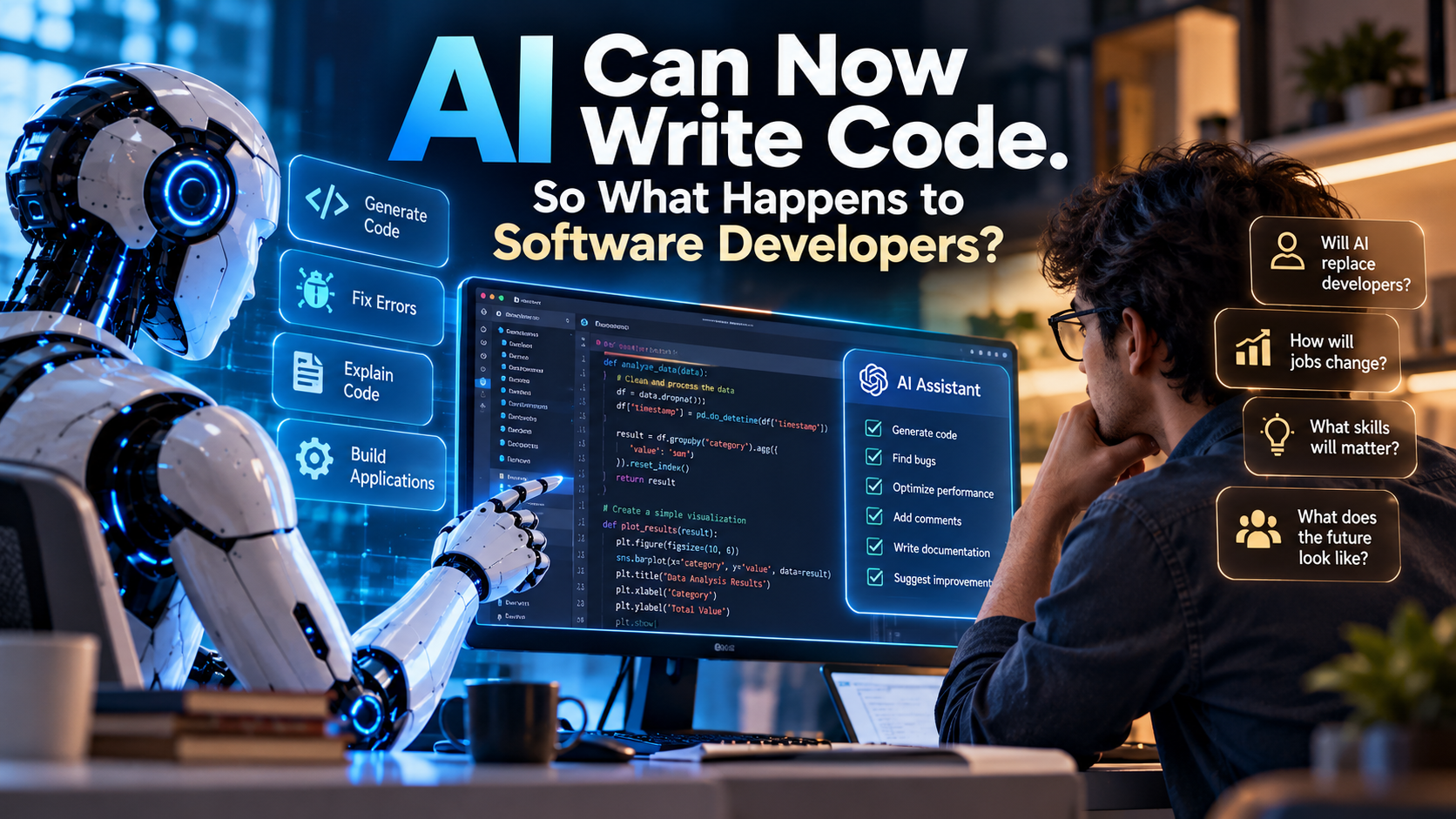
AI Can Now Write Code. So What Happens to Software Developers?
Artificial intelligence is changing software development at a remarkable pace. AI coding tools can now generate functions, explain code, identify bugs, write tests, and even help developers build complete applications from natural-language instructions. As these tools become more capable, one question is becoming increasingly important: what happens to software developers?
The answer is more complicated than simply saying AI will replace programmers. Software development involves much more than typing code. Developers have to understand business requirements, design systems, make technical decisions, solve unexpected problems, evaluate security risks, and maintain software long after it has been created.
AI Is Already Changing How Developers Write Code
Traditionally, developers spent significant amounts of time writing repetitive code, searching documentation, debugging errors, and creating basic components. AI coding assistants can now help with many of these tasks.
A developer can describe what they want in plain language and receive a suggested implementation. AI can generate functions, create database queries, explain unfamiliar code, convert code from one programming language to another, and suggest possible fixes for errors.
This does not mean developers simply press a button and receive a finished product. Generated code still needs to be reviewed, tested, integrated, and maintained. AI can produce code that looks correct while containing logical errors, security vulnerabilities, or assumptions that do not match the actual requirements of a project.
Will AI Replace Software Developers?
The more useful question may not be whether AI will replace software developers, but which parts of software development will become automated.
Repetitive programming tasks are increasingly suitable for automation. Simple features, boilerplate code, documentation, testing tasks, and straightforward code transformations can often be accelerated with AI.
However, complex software projects require decisions that go beyond generating code. Developers need to determine how different systems should interact, which technologies should be used, how information should be protected, and what trade-offs are acceptable.
These responsibilities become particularly important when software handles financial data, healthcare information, customer accounts, business operations, or other sensitive systems.
Programming Could Become More About Problem-Solving
AI may change the skills that matter most in software development. Instead of spending most of their time manually writing every line of code, developers may increasingly focus on defining problems, designing solutions, reviewing AI-generated code, and making architectural decisions.
This means understanding programming fundamentals could remain important even when AI writes more of the actual code. Developers need enough technical knowledge to recognize incorrect implementations and determine whether an AI-generated solution is appropriate.
AI Coding Tools Can Make Developers More Productive
One of the biggest potential benefits of AI coding tools is productivity. A developer who would previously spend hours creating repetitive code may be able to complete the same task much faster with AI assistance.
AI can also reduce the time spent searching for information. Developers can ask an AI assistant to explain an unfamiliar library, summarize documentation, provide examples, or help investigate an error.
For experienced developers, this can function as an additional productivity tool rather than a replacement for technical expertise.
There Is Still a Problem With AI-Generated Code
AI-generated code is not automatically reliable simply because it compiles or passes a basic test. Large language models generate responses based on patterns learned from data, and they can produce incorrect or incomplete solutions.
Developers therefore need to verify generated code carefully. Security vulnerabilities, inefficient algorithms, incorrect assumptions, outdated approaches, and subtle logical errors can all create problems if AI-generated code is accepted without review.
Testing and code review become even more important as organizations increase their use of AI development tools.
Junior Developers Could Face a Different Career Path
AI could have a particularly significant effect on entry-level software development. Junior developers traditionally learn by working on smaller tasks, fixing bugs, writing basic features, and gradually taking on more complex responsibilities.
If AI automates some of these beginner-level tasks, companies may change how they train and evaluate new developers. At the same time, developers who understand how to work effectively with AI tools may be able to learn and build software more quickly.
This could make foundational programming knowledge, system understanding, debugging ability, and problem-solving skills increasingly valuable.
The Developer's Role Could Evolve
Software developers may increasingly become orchestrators of AI-powered development workflows. Instead of manually completing every programming task, they could describe requirements, guide AI systems, evaluate their output, and connect multiple components into a reliable application.
The ability to communicate technical requirements clearly could become just as important as writing code quickly. Developers will also need to understand when AI should be trusted and when its output requires deeper human review.
What Skills Should Software Developers Learn?
As AI becomes part of everyday software development, developers can benefit from building skills that complement automation rather than competing directly with it.
- Strong programming fundamentals
- Software architecture and system design
- Debugging and testing
- Cybersecurity fundamentals
- Database and API design
- Understanding of artificial intelligence tools
- Clear technical communication
- Critical thinking and problem-solving
Developers who understand both traditional software engineering and modern AI tools may be able to work across a wider range of development tasks.
What Does the Future of Software Development Look Like?
The future of software development is unlikely to be defined by a simple choice between humans and AI. Instead, development teams may increasingly combine human decision-making with AI-assisted implementation.
Developers could spend less time on repetitive coding and more time designing systems, understanding users, reviewing solutions, managing complexity, and solving problems that cannot be easily described through a simple prompt.
As AI coding tools continue to improve, the definition of a software developer may gradually change. Writing code will remain important, but knowing what code should be written and why could become even more important.
Final Thoughts
AI can write code, but software development is more than writing code. Artificial intelligence is already changing the way developers build applications, and that transformation is likely to continue.
Rather than viewing AI only as a replacement for programmers, it can be understood as a new development tool that changes where human effort is most valuable. Developers who learn how to work with AI while maintaining strong engineering fundamentals will be better prepared for a software industry that increasingly combines human expertise with machine-generated code.