Total solar eclipse 2026: Where, when and how to watch on Wednesday?
Millions will see the sun disappear as the eclipse sweeps from the Arctic to Europe, bringing two minutes of totality.
August 12, 2026 Total Solar Eclipse: Where to See It, Timings and How to Watch Safely
Millions of people across Europe and other parts of the Northern Hemisphere will have the opportunity to witness a spectacular solar eclipse on Wednesday, August 12, 2026.
The event will begin as a partial eclipse, with the Moon gradually moving across the face of the Sun. For observers positioned along the path of totality, the Moon will eventually cover the Sun completely, briefly turning daytime into darkness.
Totality will last only a few minutes at most, making this a short but remarkable astronomical event. Here's everything you need to know about the eclipse, including where it will be visible, when it will occur and how to watch it safely.
When Is the Solar Eclipse?
The exact viewing time will depend on your location because the Moon's shadow will travel across Earth's surface from the Arctic region toward Europe.
According to the timetable provided for the event, the eclipse will progress approximately as follows:
- 15:34 GMT: The partial eclipse begins at the first location on Earth.
- 16:58 GMT: Totality begins at the first location reached by the Moon's central shadow.
- 17:46 GMT: The eclipse reaches its global maximum, with totality lasting approximately 2 minutes and 18 seconds near the center of the path.
- 17:48 GMT: Totality reaches Reykjavik, Iceland, at approximately this time.
- 18:27 GMT: Totality reaches Spain.
- 18:34 GMT: The period of totality ends globally.
- 19:58 GMT: The partial eclipse ends at the final location on Earth.
Local viewing times will vary significantly, so observers should check an eclipse timetable for their specific location.
Which Countries Will See the Total Solar Eclipse?
The path of totality is the narrow region where the Moon completely blocks the visible surface of the Sun. During the August 12 eclipse, this path will cross parts of northern Russia, Greenland and Iceland before moving into Spain and a small section of Portugal.
The event is expected to bring near-total darkness to an estimated 15 million people located within the path of totality.
Outside the path of totality, a partial eclipse will be visible over a much larger area. Much of Western Europe, parts of northwestern Africa, most of Canada and portions of the northern United States will be able to see at least some of the Moon passing in front of the Sun.
In total, weather permitting, as many as 980 million people could potentially see the Sun partially covered during the event.
Will the Eclipse Be Visible Across Europe?
Much of Europe will experience a partial solar eclipse during the evening hours, with the event occurring relatively close to sunset in many locations.
The amount of the Sun covered by the Moon will depend on where you are. Approximate coverage includes:
- Paris: Around 92 percent of the Sun covered.
- London: Around 91 percent covered.
- Berlin: Around 85 percent covered.
In many cities farther east, sunset will occur before the eclipse reaches its maximum point. As a result, observers in those areas may not be able to see the deepest stage of the eclipse.
Where Will the Eclipse Be Visible in Spain?
Spain will provide some of the most favorable viewing opportunities in Europe because several cities are positioned within the path of totality.
Locations in northern and eastern Spain expected to experience totality include Leon, Valladolid, Zaragoza, Teruel and Valencia.
Totality is expected to reach western Spain at approximately 18:27 GMT, corresponding to around 8:27 p.m. local time. Depending on the exact location, complete darkness may last for roughly 110 seconds.
Madrid and Barcelona are positioned just outside the main path of totality. Even so, observers in both cities are expected to see more than 99 percent of the Sun covered.
Will the Eclipse Be Visible in the United States and Canada?
Yes. However, the United States and Canada will not experience totality. The eclipse will appear as a partial solar eclipse in these countries.
Canada
The amount of solar coverage will vary considerably across Canada.
- St. John's, Newfoundland: Approximately 53 percent coverage.
- Montreal: Approximately 18 percent coverage.
- Toronto: Approximately 8 percent coverage.
United States
Parts of Alaska will experience the greatest amount of coverage in the United States.
- Fairbanks, Alaska: Approximately 37 percent coverage.
- Anchorage, Alaska: Approximately 28 percent coverage.
- Bangor, Maine: Approximately 24 percent coverage.
- New York: Approximately 9 percent coverage.
- Detroit: Approximately 3 percent coverage.
Because this will be a partial eclipse in the United States and Canada, observers must use appropriate eye protection throughout the event.
How Long Will Totality Last?
At the point of maximum eclipse, totality is expected to last approximately 2 minutes and 18 seconds.
The exact duration will depend on the observer's location within the path of totality. People positioned closer to the center of the path generally have a longer period of complete coverage than those closer to its edges.
In Spain, totality will last for up to approximately 110 seconds depending on the viewing location.
What Happens During a Total Solar Eclipse?
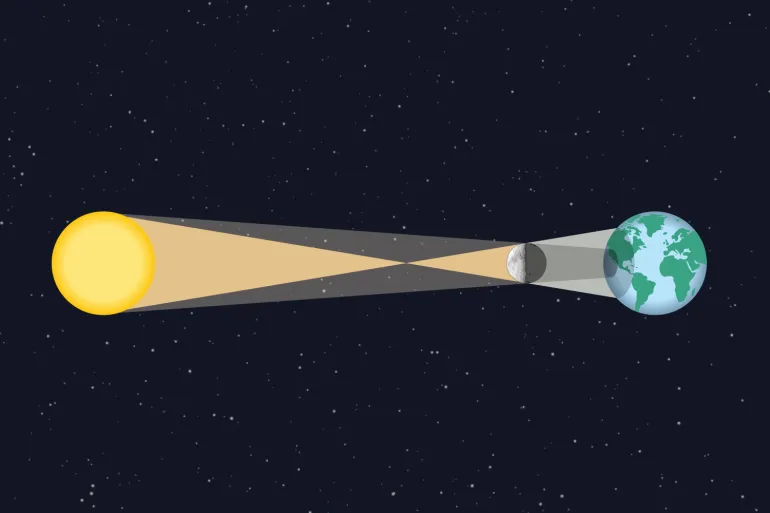
A solar eclipse occurs when the Moon moves between Earth and the Sun. From certain locations on Earth, the Moon can temporarily block some or all of the Sun's visible light.
During a total solar eclipse, the Moon completely covers the Sun's bright disk for observers within the path of totality. Daylight can quickly fade, temperatures may drop, and the sky can take on an unusual twilight-like appearance.
One of the most spectacular features becomes visible during totality: the Sun's outer atmosphere, known as the corona. The corona surrounds the dark silhouette of the Moon and can appear as a glowing, delicate halo.
How to Watch the Solar Eclipse Safely
Solar eclipses are fascinating to observe, but looking directly at the Sun without appropriate protection can cause serious and permanent eye damage.
For every stage of the eclipse when any portion of the Sun's bright surface is visible, proper solar eye protection is essential.
What You Should Do
- Use certified eclipse glasses or a safe handheld solar viewer.
- Inspect eclipse glasses before use and make sure they are not scratched, torn or otherwise damaged.
- Closely supervise children while they are using eclipse glasses.
- If you are inside the path of totality, remove your eye protection only after the Moon has completely covered the Sun.
- Put your eclipse glasses back on immediately when the Sun begins to reappear.
What You Should Never Do
- Do not use ordinary sunglasses to look directly at the Sun. They do not provide adequate protection.
- Do not look at the Sun through a camera, binoculars or telescope unless the equipment has an appropriate solar filter.
- Do not attach ordinary eclipse glasses to an unfiltered camera, telescope or binoculars. Concentrated sunlight can damage equipment and create a serious eye hazard.
Can You Look at the Eclipse Without Glasses?
There is one important exception to the requirement for eclipse glasses: the brief period of totality.
When the Moon completely covers the Sun's bright surface, observers within the path of totality can look directly at the eclipse without solar glasses.
However, this is safe only during complete totality. The moment even the first bright portion of the Sun becomes visible again, eye protection must immediately be restored.
Anyone outside the path of totality will not experience this period of complete coverage and should keep proper solar protection in place throughout the eclipse.
How to Photograph the Solar Eclipse Safely
Photographing an eclipse requires additional precautions because pointing a camera directly toward the Sun can damage the camera sensor and other components.
A proper solar filter should be used when photographing any portion of the Sun that remains visible.
During the short period of totality, when the Sun is completely covered, the filter can be removed to photograph the corona and surrounding sky. However, the filter should be replaced immediately before the Sun begins to emerge.
The same principle applies to telescopes and other optical equipment: never point unfiltered equipment toward the Sun.
How Can You Watch the Eclipse Online?
People who cannot travel to the path of totality or who have unfavorable weather conditions will still have opportunities to watch the event remotely.
NASA is scheduled to provide a live broadcast of the August 12 solar eclipse beginning at approximately 17:15 GMT.
Online viewing can be especially useful for people outside the path of totality, where the eclipse may be difficult to observe because of the local time, sunset or cloud cover.
When Is the Next Total Solar Eclipse?
The next total solar eclipse is scheduled for August 2, 2027.
The path of totality for that event will cross areas including southern Spain, North Africa, Saudi Arabia and Yemen.
The August 2027 eclipse is expected to provide another major viewing opportunity for observers across parts of Europe, Africa and the Middle East.
Final Thoughts
The August 12, 2026 solar eclipse will be a major astronomical event, particularly for observers in Iceland and Spain who are positioned within the path of totality.
Millions more people across Europe, North America and other regions will experience a partial eclipse. The amount of coverage will vary dramatically from one location to another, making local eclipse times and viewing conditions important.
Whether you are watching from the center of the path of totality or seeing only a small portion of the Sun disappear, remember that safe viewing is essential. Use certified solar protection whenever any part of the Sun's bright surface is visible, and only view the Sun without protection during the brief period of complete totality.
With the right preparation, the August 12 eclipse promises to be one of the most memorable astronomical events of 2026.