You Won't See the Curve Coming: What Alice Finnegan Taught Me About Dying
A meditation on the road that leads to Alice Finnegan — a novel that asks what's waiting on the other side of the windshield, and whether the dead are ever really finished with the living.
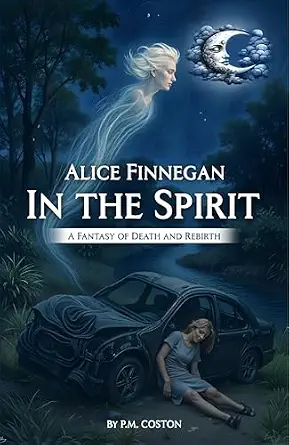
You Won't See the Curve Coming: What Alice Finnegan Taught Me About Dying
A meditation on the road that leads to Alice Finnegan — a novel that asks what's waiting on the other side of the windshield, and whether the dead are ever really finished with the living.
You are driving home. You have made this drive a hundred times — the same twists, the same familiar dark, the same certainty that you know exactly how the road behaves. You are tired, but not tired enough to stop. You tell yourself you're almost there. You always tell yourself that.
This is where Coston begins Alice Finnegan: not with a scream, but with the small, quiet decisions that precede every tragedy — the motel offered and refused, the easier highway passed over for the familiar one, the body's warnings dismissed one exit at a time. Alice is eighty-five years old, a retired language teacher, a woman who has spent a lifetime being useful, kind, and unsentimental about faith. She does not pray. She has never really needed to.
A Life Measured in Kindnesses, Not Prayers
Before you meet the woman who dies, you meet the woman who lived. Alice fed the hungry, clothed the poor, took in foster children she never once tried to keep for herself, and paid the neighborhood boys to cut her lawn without ever pretending they were family. She taught herself to say no to her own father's nightly prayers before she was even a teenager, and she never really looked back — not even when her husband Donald was dying of cancer and begged her to pray for him. She promised. She meant to. She never did. Not out of cruelty, but because Alice was, above everything else, a pragmatist. Cancer and dying were simply part of living, and asking wasn't going to change the outcome.
That's the quiet unease Coston plants early: a woman who has spent eighty-five years doing good without asking anything from heaven in return, now approaching a moment when heaven, whether she believes in it or not, may be waiting for an answer. You start reading her ordinary evening — the pottery show, the state award, the two-lane road she's driven a thousand times — and a low hum of dread creeps in, because you already know: no one gets a chapter this gentle for nothing.
The Longest Drive Home in Fiction
On an October evening in 1998, Alice pushes her tired body and her gutless little car down a familiar two-lane road instead of stopping at either of the two motels she passes. She drifts off the shoulder once. Twice. Her hands go sweaty. Every instinct in her body tells her to pull over — and every instinct loses to the pull of "almost home." Coston stretches this drive out with a patience most thrillers wouldn't dare: mile markers, half-remembered advice from a father who taught her to drive sixty years earlier, a curve she's taken a thousand times that, tonight, she won't survive. It's the kind of slow-motion dread that horror readers recognize instantly — not a monster in the dark, but your own body outrunning your own good sense, and nothing you can do to stop it once it starts.
The Stranger on the Other Road
Coming from the opposite direction is Jeffrey Higgins — a man whose life has already brushed against Alice's more than either of them ever realized. He was her star language student decades earlier, a boy who studied French and Italian under her before the war took him overseas, where he was commissioned into the Army Air Corps and eventually placed in command of Italian prisoner-of-war camps stretched across three states. He conducted religious services there as an unofficial deacon, fluent in the language of men who had nowhere else to turn. Now middle-aged, driving to collect his mother for the very pottery show Alice has just left, a detour to avoid traffic puts him on the one stretch of road where her car goes off the pavement and into the Middle River.
It is Jeffrey who reaches the wreck first. Jeffrey who holds her hand while a farmer and his wife tear the car apart with a fence post and a hunting knife to free her. And it is Jeffrey — the deacon who never became a priest, the student she never knew she'd shaped so deeply — who speaks to her in the Italian she once taught him, and who prays over her when her own voice has nothing left to give.
What Waits on the Other Side of the Windshield
This is not a car-crash novel. It's a ghost story about the seconds after impact — the ones most fiction skips past, the ones Coston refuses to look away from. As Alice's life ends, the novel doesn't cut to black. It follows her. It lingers in the space between her last breath and whatever comes next, in the quiet, unbearable intimacy of a soul departing a body it has occupied for eighty-five years, pausing just long enough to say goodbye to the one person who stopped to pray for her.
Her soul lingered a moment longer, over the stranger who had stopped to pray for her — and then it was gone.
Woven through the accident is the wider Finnegan family — four children raised without pressure toward faith, including a son who became a Navy captain his father was fiercely proud of, and a youngest, the family's black sheep, who died in Vietnam of a heroin overdose years before this night. None of them are in the car with her. All of them are, in some sense, riding along anyway, because a death like this doesn't just end one story — it reopens every story connected to it.
You will finish this book thinking about the last conversation you didn't have, the drive home you shouldn't have rushed, the prayer you promised and never said. That's the quiet horror at the center of Alice Finnegan: not what waits for us after death, but what we leave unfinished before it. It's a slow chill rather than a jump scare — the kind that follows you out of the room, sits with you at dinner, and asks, gently, whether you've called the people you love lately.